| # | Problem | Pass Rate (passed user / total user) |
|---|---|---|
| 11195 | Hanoi |
|
| 11203 | Perfect Number |
|
Description
The Tower of Hanoi is a mathematical game puzzle. It consists of three rods, which are A, B and C. The puzzle starts with n disks in ascending order of size on rod A, the smallest at the top.
The objective of the puzzle is to move the entire stack to another rod, obeying the following simple rules:
1. Only one disk can be moved at a time.
2. Each move consists of taking the upper disk from one of the stacks and placing it on top of another stack i.e. a disk can only be moved if it is the uppermost disk on a stack.
3. No disk may be placed on top of a smaller disk.
Write a program to simulate the moves of the disks. Print the number of disk which is moved in each step.
For example, if n = 3, the moves of each steps are:
move disk 1 from rod A to rod C
move disk 2 from rod A to rod B
move disk 1 from rod C to rod B
move disk 3 from rod A to rod C
move disk 1 from rod B to rod A
move disk 2 from rod B to rod C
move disk 1 from rod A to rod C
You should print out:
1
2
1
3
1
2
1
The following graph is an easy example when n = 3:
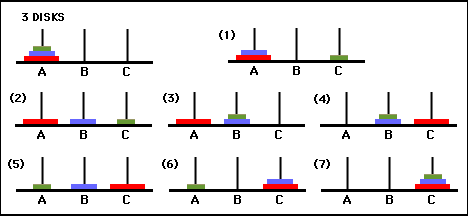
You only need to complete following function:
#include <stdio.h>
#include "function.h"
void hanoi(int n, char A, char B, char C)
{
// Write your code here
}
You may refer to [11656 Simple Permutation] for the submission specifications.
Input
An integer n (0<n<20), which means the number of disk.
Output
Print out the number of disk which is moved in each step, and there is a '\n' at the end of each line.
Sample Input Download
Sample Output Download
Partial Judge Code
11195.cppPartial Judge Header
11195.hTags
Discuss
Description
A perfect number is a positive integer that is equal to the sum of its proper positive divisors, that is,
the sum of its positive divisors excluding the number itself (其正因數的總和,但不包含自己本身)
Ex: is 6 a perfect number?
since 1,2,3 are proper positive divisors of 6 , and the sum of them = 1+2+3 = 6
Thus , 6 is a perfect number
The question is :
Given a integer number N, print out all the perfect number <= N
In this problem, you only need to implement a function called isPerfect(int n).
It returns 1 if the number is perfect number , otherwise returns 0.
Main program is below. It calls the function you implement and print out the results.
---------------------------------------------------------------------------------------------------------
#include <stdio.h>
//-------------------------------------------
// Implement the function here
//-------------------------------------------
int main(){
int N, i;
scanf("%d",&N);
for(i=1; i<=N; i++){
if(1==isPerfect(i)) printf("%d\n",i);
}
}
----------------------------------------------------------------------------------------------------------
Input
There is only a integer N. (N<=10000)
Output
All perfect numbers that are smaller or equal to N