| # | Problem | Pass Rate (passed user / total user) |
|---|---|---|
| 10990 | cheat sheet |
|
| 11380 | Chen Midterm1- Problem1 |
|
| 11381 | Chen Midterm1- Problem2 |
|
| 11382 | Chen Midterm1- Problem3 |
|
Description
Linked list
typedef struct _Node {
int data;
struct _Node *next;
} Node;
/* print the content of the linked list.*/
void printList(Node *head)
{
Node *temp;
for(temp=head; temp!=NULL; temp=temp->next) {
printf("%d ", temp->data);
}
}
/*Insert a node after the node pointed by nd.
Return 1 if insertion succeeds.
Otherwise, return 0.*/
int insertNode(Node* nd, int data)
{
if (nd != NULL) {
Node* temp = (Node*)malloc(sizeof(Node));
temp->data = data;
temp->next = nd->next;
nd->next = temp;
return 1;
}
return 0;
}
/*Delete a node after the node pointed by nd.
Return 1 if insertion succeeds.
Otherwise, return 0.*/
int deleteNode(Node* nd)
{
if (nd != NULL) {
Node* temp = nd->next;
if (temp != NULL) {
nd -> next = temp->next;
free(temp);
return 1;
}
}
return 0;
}
Binary tree
typedef struct _node {
int data;
struct _node *left, *right;
} BTNode;
Tree traversal
- Pre-order: visit root, left subtree, and right subtree
- In-order: visit left subtree, root, and right subtree
- Post-order: visit left subtree, right subtree, and root
Expression order
- Prefix: operator, left operand,and right operand
- Infix: left operand, operator, and right operand
- Postfix: left operand, right operand, and operator
Syntax tree
The internal nodes are operators, and the leaves are operands.
Recursive evaluation of prefix expression
/*It is a pseudo code */
int evalBoolExpr(){
char c = getchar();
If c is an operator
op1 = evalBoolExpr();
op2 = evalBoolExpr();
return op1 c op2;
Else if c is a variable
return the value of c;
}
Grammar of infix expression with parenthesis
- EXPR = FACTOR| EXPR OP FACTOR
- FACTROR = ID | (EXPR)
/*Suppose expr[] is an array of expression and pos is the current position, which initially is strlen(expr)-1. */
/*-------------------------------------*/
BTNode* makeNode(char c)
{
int i;
BTNode *node = (BTNode*)malloc(sizeof(BTNode));
set node->data
node->left = NULL;
node->right = NULL;
return node;
}
/*-------------------------------------*/
BTNode* FACTOR()
{
char c;
BTNode *node = NULL;
if (pos>=0) {
c = expr[pos--];
if (c is an ID) {
node = makeNode(c);
} else if (c==‘)’) {
node = EXPR();
if(expr[pos--]!= '(') {
printf("Error!\n");
freeTree(node);
}
}
}
return node;
}
/*-------------------------------------*/
BTNode* EXPR()
{
char c;
BTNode *node = NULL, *right=NULL;
if (pos>=0) {
node = right = FACTOR();
if (pos>0) {
c = expr[pos];
if (c is an operator) {
node = makeNode(c);
node->right = right;
pos--;
node->left = EXPR();
}
}
}
return node;
}
Input
Output
Sample Input Download
Sample Output Download
Tags
Discuss
Description
[Partial Judge Problem]
Problem description:
We define a Josephus game as follows:
1. There are n people , numbered as 1 to n, in a circle and arranged in clockwise.
2. The person with ID = 1 is the killer at the beginning of the game.
3. If the number of survivor is even :
The killer will kill the person who is oppisite from himself .
The person next to the victim in clockwise direction will be the new killer.
Ex: If there are 4 people in the game , the 1st victim will be 3 .
4 will become the new killer.
1(killer) 1
4 2 -----> 4(killer) 2
3(victim)
4. If the number of survivor is odd :
The killer will kill the person next to himself in counter-clockwise direction.
The person next to the victim in counter-clockwise direction will be the new killer.
Ex:
1 1(killer)
4(killer) 2(victim) -----> 4
5. The winner is the one survive at the end of the game.
Judge language : C
Your task is to implement following functions :
- (Required) Node* createList(int n, Node*);
- (Required) int solveJosephus(int numOfPeople , Node* head);
- (Optional) other functions you will need
Submit format:
#include <stdio.h>
#include <stdlib.h>
#include "function.h"//------------------------------------------
/*Other functions*/
//------------------------------------------
int solveJosephus(int n , Node* head){
/*your code here*/
}
Node* createList(int n , Node* head){
/*your code here*/
}
Input
There are multiple lines in an input testcase .
Each line represents a Josephus game
Each line contains an integer indicates the number of people joining the josephus game.
The input format is determined by the judge code
You don't have to worry about it.
Output
Show the winner of each josephus game.
The output format is determined by the judge code.
You don't have to worry about it .
Sample Input Download
Sample Output Download
Partial Judge Code
11380.cPartial Judge Header
11380.hTags
Discuss
Description
This is a partial judge problem (Judge Language : C)
Please download the partial judge code and header.
Then, implement 2 functions : buildTree() and showPreorder()
You have to build the binary tree according to its inorder and postorder.
Next , print out the preorder of the binary tree!
Submit format:
#include <stdio.h>
#include <stdlib.h>
#include "function.h"
Node* buildTree(int* inorder, int* postorder, int inorder_start, int inorder_end){
/*YOUR CODE HERE*/
}
void showPreorder(Node* root){
/*YOUR CODE HERE*/
}
Input
There are 3 lines for inputs.
The first line contains an integer N , which indicates the number of nodes of the binary tree.
The second line is the inorder traversal of the binary tree
The third line is the postorder traversal of the binary tree
※Note that there are not duplicated integers in the binary tree
Output
Print out the preorder traversal of the binary tree.
Note that :
1.There is an whitespace between each integer.
2.There is an whitespace after the last integer.
3.Threre is no need to add "\n" at last
Sample Input Download
Sample Output Download
Partial Judge Code
11381.cPartial Judge Header
11381.hTags
Discuss
Description
Give a postfix expression, which only has 2 operators, ‘+’ and ‘-’,and positive integers. Print the result.
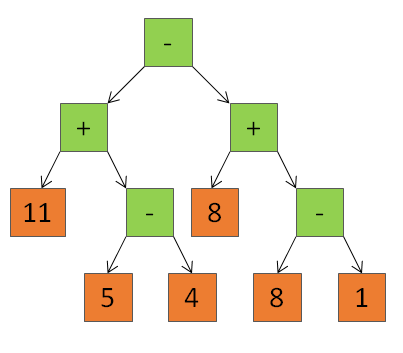
Input
The input contains exactly 1 sequences of postfix expression. It contains operators, ‘+’ and ‘-’,and positive integers separated by a space.
The length of input sequence is smaller than or equal to 40
Output
The output is the result of the expression. (Without a newline symbol)