| # | Problem | Pass Rate (passed user / total user) |
|---|---|---|
| 11195 | Hanoi |
|
| 11649 | World of Tanks |
|
| 11656 | Simple Permutation |
|
Description
The Tower of Hanoi is a mathematical game puzzle. It consists of three rods, which are A, B and C. The puzzle starts with n disks in ascending order of size on rod A, the smallest at the top.
The objective of the puzzle is to move the entire stack to another rod, obeying the following simple rules:
1. Only one disk can be moved at a time.
2. Each move consists of taking the upper disk from one of the stacks and placing it on top of another stack i.e. a disk can only be moved if it is the uppermost disk on a stack.
3. No disk may be placed on top of a smaller disk.
Write a program to simulate the moves of the disks. Print the number of disk which is moved in each step.
For example, if n = 3, the moves of each steps are:
move disk 1 from rod A to rod C
move disk 2 from rod A to rod B
move disk 1 from rod C to rod B
move disk 3 from rod A to rod C
move disk 1 from rod B to rod A
move disk 2 from rod B to rod C
move disk 1 from rod A to rod C
You should print out:
1
2
1
3
1
2
1
The following graph is an easy example when n = 3:
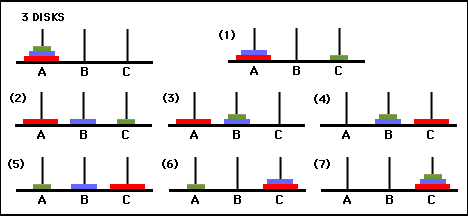
You only need to complete following function:
#include <stdio.h>
#include "function.h"
void hanoi(int n, char A, char B, char C)
{
// Write your code here
}
You may refer to [11656 Simple Permutation] for the submission specifications.
Input
An integer n (0<n<20), which means the number of disk.
Output
Print out the number of disk which is moved in each step, and there is a '\n' at the end of each line.
Sample Input Download
Sample Output Download
Partial Judge Code
11195.cppPartial Judge Header
11195.hTags
Discuss
Description
Copyright © I2P_EECS_MID1_1
Now you are in the World of Tanks !!!

Your mission is to follow the instructions and pick the coins : )
You will get a map of the world like this:
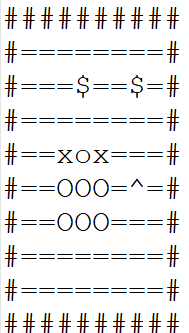

 is your tank with size 3x3(xox is the head of the tank), and $ represents a coin, # represents the wall, ^ represents the hill.
If you tank (3x3 body) is above the $, you will pick it up($ can't be counted again). If # or ^ is in front of the tank(in front of the xox, tank's front part), you can not move. Coins' position don't overlap initial tank's position.
The tank has four forward directions(South, East, North, West). Its direction is where xox heads. Notice that the upper of the map is the North, and the initial direction of tank is not always North.
And you will receive a sequence of instructions, which contains F (takes a step along the tank's head direction), R(tank's head turns right), and L(tank's head turns left). Instructions like R and L only change tank's head direction, and don't affect tank's position(would not cause moving).
Your mission is to receive the instructions and dirves the tanks in order to collect coins, and report the amount of coins you get in the end.
Notice: The sample input in the below seems not aligned because the size of each character is not identical. You can see the map above(it is the same as sample input) if you want to see clearly.
There are sample codes for you:
Input
The first line of the input contains four things:
1. The rows of the map (0 < rows < 100)
2. The columns of the map (0 < cols < 100)
3. The total length of instructions (0 < instructions's length < 100)
4. The initial tank's direction(N, E, S, T)
The second line is the content of instructions.
For the next lines, they illustrate the map.
Output
The number of coins you get. (printf "\n" in the end)
Sample Input Download
Sample Output Download
Tags
Discuss
Description
Writers : jjjjj19980806 & pclightyear
Given an integer n, please output a sequence of integers as described below :
(1) The sequence consists of 2n – 1 integers.
(2) Output format : 1 2 … n-1 n n-1 … 2 1
(3) There is a whitespace behind each integer except for the last number.
(4) Remember to output '\n' after you print out your answer.
Note :
(1) This is a partial judge problem. Make sure to download partial judge code and partial judge header we give to you. Before you submit your code, your code should be compiled successfully on your computer. (If you run into any trouble, feel free to ask on ilms.)
(2) These keywords should not appear in your submission : for, while, goto. (i.e. you can’t use any loop, otherwise your will receive compiler error.)
(3) You can’t declare any global variable and function except for “print()” (which is declared in the header file we give to you) in your code.
(4) You need to choose C Language instead of C++.
(5) Your submission will look like :
#include <stdio.h>
#include "function.h"
// Not "11656.h" !!
void print(int level, int n){
// add your code here!
}
Input
There is only one integer n in the input file.
- 1 ≤ n ≤ 10
Output
As described above.
You can find out more information in sample output.