| # | Problem | Pass Rate (passed user / total user) |
|---|---|---|
| 11194 | Stairs Climbing |
|
| 11195 | Hanoi |
|
| 11196 | Eight Queen |
|
Description
Bob is a man who wants to climb 3 step stairs.
Suppose he can only climb 1 or 2 step at a time.
Then , there are 3 possible ways to climb 3 step stairs
(1) 1 step + 1 step + 1 step
(2) 1 step + 2step
(3) 2 step + 1step
The question is : if Bob want to climb X step stairs.
How many possible ways are there to climp X step stairs.
Input
An integer N represents the number of testcases.
Then , there are following N lines.
Each line contain an integer X that represents the number of stairs in that testcase.
P.S. 1<= X <=40
Output
An integer represents the number of possible way to climb N stairs.
Note that you have to add '\n' at the end of output
Sample Input Download
Sample Output Download
Tags
Discuss
Description
The Tower of Hanoi is a mathematical game puzzle. It consists of three rods, which are A, B and C. The puzzle starts with n disks in ascending order of size on rod A, the smallest at the top.
The objective of the puzzle is to move the entire stack to another rod, obeying the following simple rules:
1. Only one disk can be moved at a time.
2. Each move consists of taking the upper disk from one of the stacks and placing it on top of another stack i.e. a disk can only be moved if it is the uppermost disk on a stack.
3. No disk may be placed on top of a smaller disk.
Write a program to simulate the moves of the disks. Print the number of disk which is moved in each step.
For example, if n = 3, the moves of each steps are:
move disk 1 from rod A to rod C
move disk 2 from rod A to rod B
move disk 1 from rod C to rod B
move disk 3 from rod A to rod C
move disk 1 from rod B to rod A
move disk 2 from rod B to rod C
move disk 1 from rod A to rod C
You should print out:
1
2
1
3
1
2
1
The following graph is an easy example when n = 3:
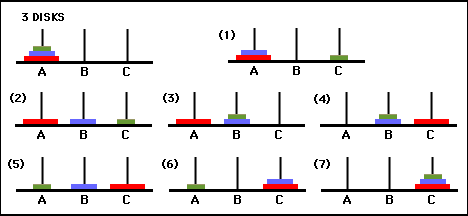
You only need to complete following function:
#include <stdio.h>
#include "function.h"
void hanoi(int n, char A, char B, char C)
{
// Write your code here
}
You may refer to [11656 Simple Permutation] for the submission specifications.
Input
An integer n (0<n<20), which means the number of disk.
Output
Print out the number of disk which is moved in each step, and there is a '\n' at the end of each line.
Sample Input Download
Sample Output Download
Partial Judge Code
11195.cppPartial Judge Header
11195.hTags
Discuss
Description
Each chessboard has numbers in the range 1 to 100 written on each square and is supplied with 8 chess queens. The task is to place the 8 queens on the chess board in such a way that no queen threatens another one, and so that the sum of the numbers on the squares selected is the maximum . (For those unfamiliar with the rules of chess, this implies that each row and column of the board contains exactly one queen, and each diagonal contains no more than one queen.)
Write a program that will read in the number and details of the chessboards and determine the highest scores possible for each board under these conditions.
Input
Input will consist of K (the number of boards), on a line by itself, followed by K sets of 64 numbers, each set consisting of eight lines of eight numbers. Each number will be a non-negative integer less than 100. Each case is separated by a blank line. There will never be more than 20 boards.
Output
The outputs of all test cases should be printed in order. For each test case a line, print the highest score.