| # | Problem | Pass Rate (passed user / total user) |
|---|---|---|
| 11413 | Rational Class |
|
| 11414 | Matrix Computation |
|
Description
- Use integer variables to represent the private data of the class─the numerator and the denominator.
- Provide a constructor that enables an object of this class to be initialized when it's declared. The constructor should contain default values in case no initializers are provided and should store the fraction in reduced form. For example, the fraction 2/4 would be stored in object as 1 in the numerator and 2 in the denominator.
- Provide public member functions that perform each of the following tasks:
- Adding two Rational numbers. The result should be stored in reduced form.
- Multiplying two Rational numbers. The result should be stored in reduced form.
- Printing Rational numbers in form a/b, where a is the numerator and b is the denominator.
- You need to implement a private member function reduce() that will be used in your constructor and the about public arithmetic member functions to derive the required reduced form.
- function.h: Class definition of Rational.
- function.cpp: Member-function definitions of Rational.
- main.cpp: A driver program to test your class implementation.
#include <iostream>
#include "function.h" // include definition of class Rational
using namespace std;

int main()
{
    char s1;
    int s2, s3, s4, s5;

    Rational x;
    while(cin >>s1>>s2>>s3>>s4>>s5)
    {
        if(cin.eof())
        {
            break;
        }
        Rational c(s2, s3), d(s4, s5);
        if(s1 == '+')
        {
            x = c.addition( d ); // adds object c and d; sets the value to x
            x.printRational(); // prints rational object x
        }
        else if(s1 == '*')
        {
            x = c.multiplication( d ); // multiplies object c and d
            x.printRational(); // prints rational object x
        }
    }
}

int gcd(int a, int b){
    return (b == 0) ? a : gcd(b, a % b);
}
#ifndef RATIONAL_H
#define RATIONAL_H
class Rational
{
    public:
        Rational( int = 0, int = 1 ); // default constructor
        Rational addition( const Rational & ) const; // function addition
        Rational multiplication( const Rational & ) const; // function multi.
        void printRational () const; // print rational format

    private:
        int numerator; // integer numerator
        int denominator; // integer denominator
        void reduce();
}; // end class Rational

int gcd(int a, int b);
#endif
- Step 1. Include function.h into function.cpp and then implement your function.cpp. (You don’t need to modify function.h and main.cpp)
- Step 2. Submit the code of function.cpp into submission block.
- Step 3. Check the results and debug your program if necessary.
Input
There are five strings in each line: S1 S2 S3 S4 S5
- S1 represents an operator (+,*).
- S2 and S3 represent the numerator and denominator of the first operand ,respectively.
- S4 and S5 represent the numerator and denominator of the second operand, respectively.
Output
For every given operation, your program should print the corresponding result followed by a new line character.
Sample Input Download
Sample Output Download
Partial Judge Code
11413.cppPartial Judge Header
11413.hTags
Discuss
Description
Create a class Matrix to represent an N x N matrix.
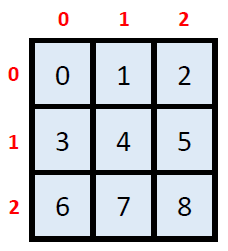
Provide public member functions that perform or derive:
- Interchanging two rows.
- Rotating Matrix by 90° clockwise.
- Rotating Matrix by 90° counter clockwise.
- Checking if Matrix is symmetric or not. If yes, print “yes”, otherwise, print “no”.
Hint:
- Symmetric
A matrix A = (aij) is symmetric if its entries are symmetric with respect to the main diagonal, that is, aij = aji, for all indices i and j.
The following 3 x 3 matrix is symmetric:
1 7 3
7 4 -5
3 -5 6
Input
The first line contains an integer N (2<=N<=50), which means the size of the matrix. The total number of elements in the matrix is thus N x N.
For the next N lines, each line contains N integers, specifying the elements of the matrix.
The last line has two integers, which mean two row indices for performing row exchange.
All of the integers in the same line are separated by a space.
Output
Print out the corresponding results with a new line character at the end of each result.