| # | Problem | Pass Rate (passed user / total user) |
|---|---|---|
| 11758 | A - Markov Matrix |
|
| 11759 | B - Great Depression Again |
|
| 11760 | C - Stable Sort |
|
| 11761 | D - Determinant |
|
| 11762 | E - Reverse Linked List |
|
| 11763 | F - Bipartite Graph |
|
| 11770 | G - XOR |
|
Description
Writer: jjjjj19980806 Description: pclightyear Difficulty: ★★★☆☆
In mathematics, a Markov matrix is a square matrix used to describe the transitions of a Markov chain. Each of its entries is a nonnegative real number representing a probability. It has found use throughout a wide variety of scientific fields, including population genetics.
Consider a country with n cities. Originally, each city has its own population, which can be described as a state vector X0. As the time pass by, the population will move from one city to another. The whole progress can be described as a n × n Markov matrix A.
In this problem, if the state vector of the city population now is Xn, after a year, the state vector will become Xn+1, where Xn+1 = AXn.
Now, you are given the original population in each city by a state vector X0 and the Markov matrix A. You need to calculate how many years it takes to let the first city’s population to drop below or equal to a specific number p, or it will never drop below p.
Input
The first line contains an integer T, representing the number of test cases.
For each test case:
The first line contains an integer n, representing the number of the cities.
The next n lines contain n floating-point number aij, representing each entry in the Markov matrix A.
The next line contains n integers Xi, representing each entry in the state vector X0.
The next line contains an integer p, representing the specific number of population.
It is guaranteed that:
- 1 ≤ T ≤ 5
- 1 ≤ n ≤ 5
- 0 ≤ X0i ≤ 106
Output
Please output how many years it takes to let the first city’s population to drop below p, or output "Never" if it will never drop below p.
Sample Input Download
Sample Output Download
Tags
Discuss
Description
Writer: jjjjj19980806 Description: pclightyear Difficulty: ★★★★★
As you all know, Kim Jong-un is the Chairman of the Workers' Party of Korea and supreme leader of North Korea. Recently, more and more countries and international bodies have been imposing economic sanctions against North Korea. The import of the raw material of all kind decreases dramatically, and the automobile industry in North Korea is suffering from severe depression again. Reorganization of the whole industry is needed to make North Korea GREAT AGAIN.
According to the survey, there are n factory in North Korea. Each of them can produce two kinds of cars (car A & car B). Now, the supreme leader wants to assign x factory to produce car A and y factory to produce car B (i.e. no factory will produce two kinds of car at the same time.) so that the net profit will become maximum. However, due to the shortage of the raw material, it is possible that some factory will not produce any cars (i.e. x + y <= n).
The supreme leader will give you the net profit each factory can make by producing car A and car B. Your program need to output the name of the x factory which produce car A in lexicographical order. If there are multiple answers, you need to output the one such that the total net profit of car A is maximum.
DO NOT DISAPPOINT HIM!!
Input
The first line contains three integers n, x, y, representing the total number of factory, the number of factory planned to produce car A, and the number of factory planned to produce car B. (according to the supreme leader's demand)
The next n lines contains one string si and two integers ai, bi, representing the name of each factory, and the net profit each factory can make by producing only car A or only car B.
It is guaranteed that :
- 0 < n, x, y ≤ 500
- x + y <= n
- 1 ≤ | si | ≤ 20
- 0 < ai, bi < 106
- ai ≠ aj, bi ≠ bj if i ≠ j.
- No duplicate names appears.
Output
Please output the list of x factory that need to produce car A in lexicographical order so that it will maximum the net profit.
Sample Input Download
Sample Output Download
Tags
Discuss
Description
Writer: jjjjj19980806 Description: pclightyear Difficulty: ★★☆☆☆
Given a list of students and their score, you have to sort their score in decreasing order.
If there are many students with the same score, you need to maintain their relative order in the original list.
That is, if whenever there are two students A and B with the same score and with A appearing before B in the original list, A will appear before B in the sorted list.
Reference: https://en.wikipedia.org/wiki/Category:Stable_sorts
Input
The first line contains one integer n, representing the number of students.
The next n lines contain a string and an integer si and ai, representing the name of each student and his/her score.
It is guaranteed that :
- n ≤ 105
- 1 ≤ | si | ≤ 20
- 0 ≤ aij ≤ 100
Output
After sorting, please output the list of students' names, each name with a line.
Sample Input Download
Sample Output Download
Tags
Discuss
Description
Writer: jjjjj19980806 Description: pclightyear Difficulty: ★★★☆☆
In linear algebra, the determinant (行列式) is a useful value that can be computed from the elements of a square matrix. The determinant also has many useful properties. For example: Assume we have a square matrix A. Then the determinant of A equals to zero if and only if A is not invertible.
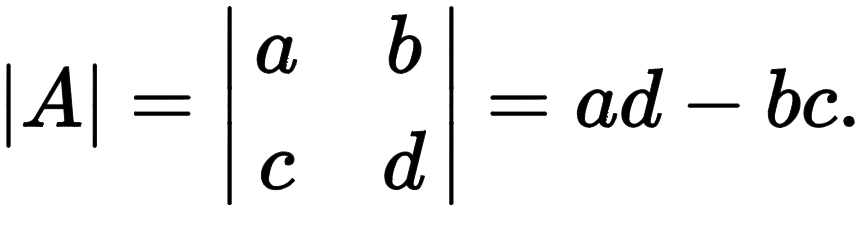
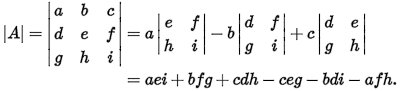
Given a n × n square matrix A, you have to calculate the determinant of A. (Denoted by det(A))
Note:
(1) We can define the determinant of a 2 × 2 matrix as below:
(2) We can calculate the determinant of a 3 × 3 matrix as below:
Input
The first line contains one integer n, representing the size of A.
The next n lines contains n integers aij, representing each entry in A.
It is guaranteed that :
- 1 ≤ n ≤ 8
- -16 ≤ aij ≤ 15
Note that det(A) may exceed INT.
Output
Please output a line contains the value of det(A).
Sample Input Download
Sample Output Download
Tags
Discuss
Description
Writer: jjjjj19980806 Description: pclightyear Difficulty: ★☆☆☆☆
Given a linked list, you have to reverse it and output the result.
You have to implement four function:
1. Node* Create_List(Node*, int);
This function is used to create the linked list according to the input.
2. Node* Reverse_List(Node*);
This function is used to reverse the given linked list.
3. void Print_List(Node*);
This function is used to print out the key value in the linked list.
4. void Free_List(Node*);
This function is used to free the memory space.
Input
The first line contains one integer n, representing the number of nodes in the linked list.
The next lines contains n integers, each integer represents a node in the linked list.
It is guaranteed that :
- 1 ≤ n ≤ 10
- 0 ≤ ai ≤ 100
Output
You need to output the reversed linked lists.
Each key value is separated by "->".
Sample Input Download
Sample Output Download
Partial Judge Code
11762.cPartial Judge Header
11762.hTags
Discuss
Description
Writer: jjjjj19980806 Description: pclightyear Difficulty: ★★★★☆
Given an undirected graph G, you have to check whether it is a bipartite graph (二分圖) or not.
Input
The first line contains an integer T, representing the number of test cases.
For each test case:
The first line contains two integers n, m, representing the number of vertices and the number of edges.
The next m lines contain two integers u, v, representing that there is an undirected edge between vertex u and vertex v.
It is guaranteed that:
- 1 ≤ T ≤ 10
- 2 ≤ n ≤ 1000
- n-1 ≤ m ≤ n2
- 1 ≤ u, v ≤ 1000
- NO multiple edge
- NO self cycle
- the graph is connected
Output
For each graph G, if G is a bipartite graph, please output "Yes", otherwise please output "No".
Sample Input Download
Sample Output Download
Tags
Discuss
Description
Writer: jjjjj19980806 Description: pclightyear Difficulty: ★★★☆☆
Given n numbers, you need to find a number k such that SUM is minimum,
where we define SUM = ( a1 ^ k ) + ( a2 ^ k ) + ... + ( an ^ k )
(^ stands for the "xor" bitwise operation of the two operand)
Input
The first line contains an integer n, representing the number of numbers.
The next line contains n integers ai, representing each given number.
It is guaranteed that:
- n ≤ 105
- 0 ≤ ai ≤ 106
- All numbers ( ai and k ) are unsigned numbers
Output
Please output the value of SUM.
Note SUM may exceed INT.