| # | Problem | Pass Rate (passed user / total user) |
|---|---|---|
| 12504 | DS_2019Fall_Quiz_3 |
|
Description
Disjoint set is a beautiful data structure. In this quiz, you need to implement 3 operations.
|
1 p q |
Union the sets containing p and q. If p and q are in the same set, do nothing. |
|
2 p q |
Move p to the set containing q. If p and q are in the same set, do nothing. |
|
3 p |
Print the number of elements and the sum of elements in the set containing p. |
Initially, there are n sets. {1}, {2}, {3},......., {n}
Example:
Initialization: {1}, {2}, {3}, {4}, {5}
After operation 1 1 2: {1, 2}, {3}, {4}, {5}
After operation 1 3 4: {1, 2}, {3, 4}, {5}
After operation 2 2 5: {1}, {3, 4}, {2, 5}
After operation 1 1 5: {3, 4}, {1, 2, 5}
Hint:
The move-operation is a little difficult in the tree representation. If you have no idea about it, you can take the following method as a reference.
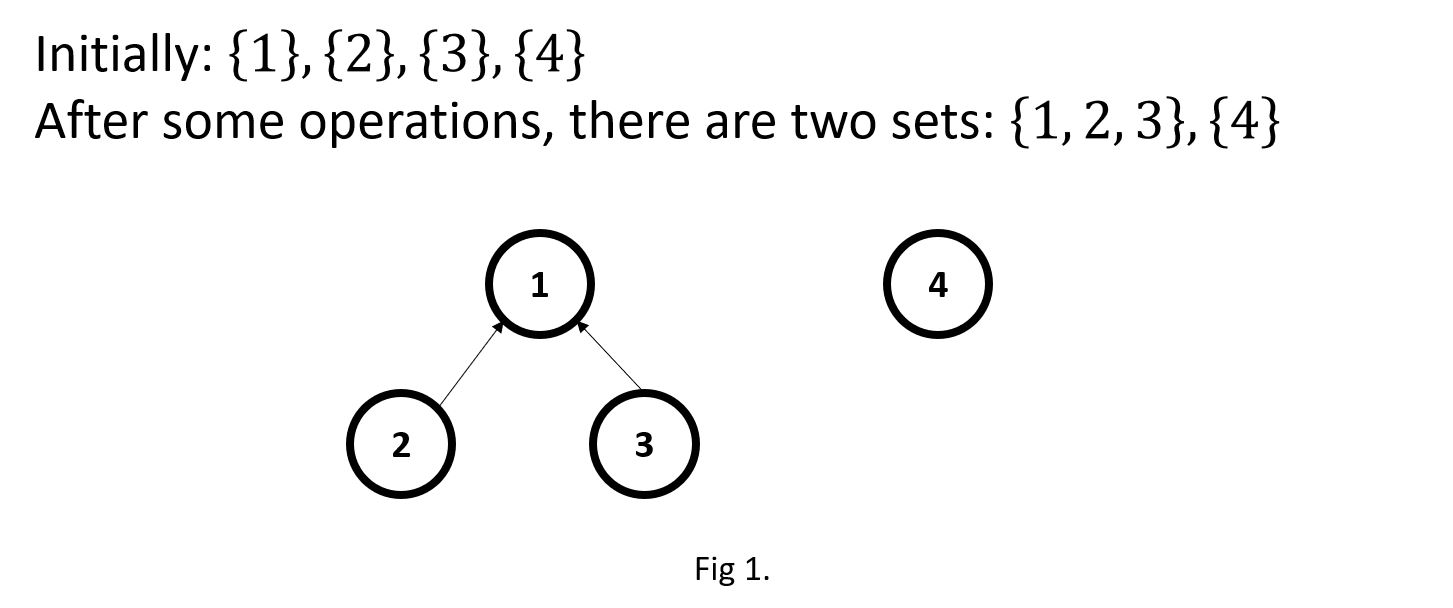
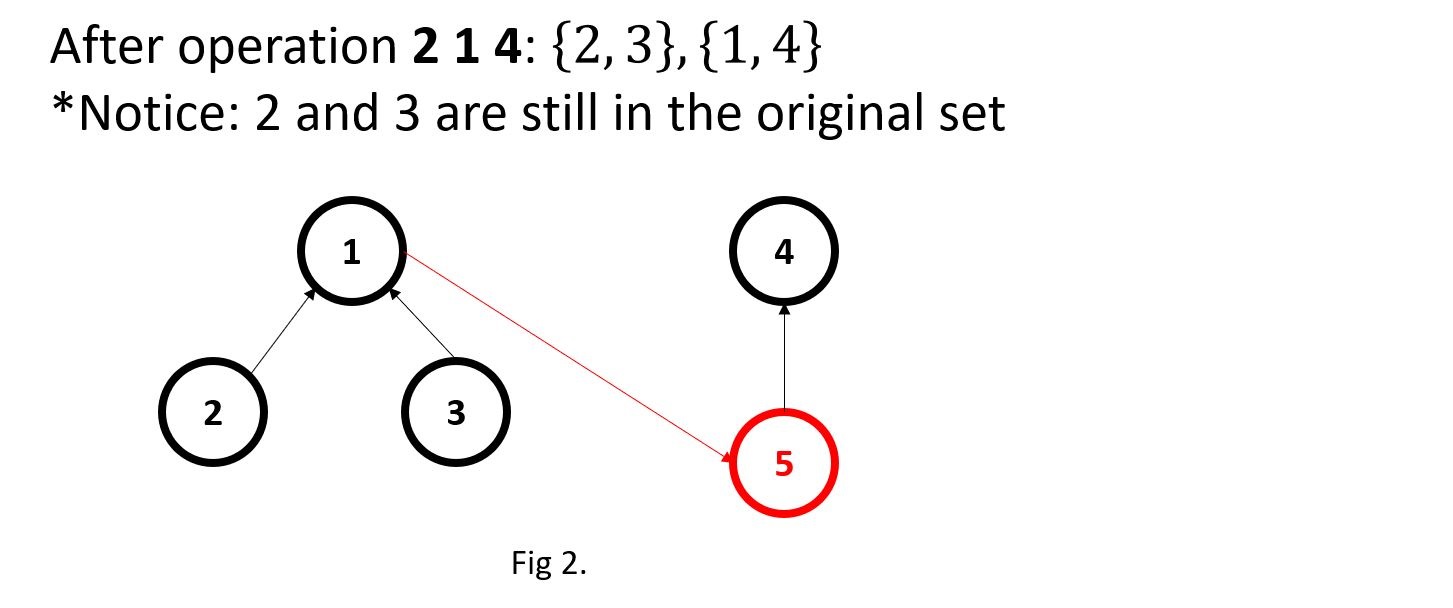
Method: When moving an element to another set, you should map this element to a new element.
And for all operations after that, use the new element instead of the old one.
Example:
Note:
Time is limited, you should find out an efficient implementation.
You are not allowed to use STL.
Input
The input will contain one or more testcases.
Each testcase begins with a line containing two integers n and m, the number of sets, and the number of commands.
Each of the next m lines contains a command.
1 <= n, m <= 100000
1 <= p, q <= n
Output
For each type-3 command, output the number of elements and the sum of elements separated by one space.
Followed by a newline character '\n'.