| # | Problem | Pass Rate (passed user / total user) |
|---|---|---|
| 12448 | Hu_cheatsheet |
|
| 12461 | Reservoir's Volume |
|
| 12560 | Permutation With Repetition |
|
| 12594 | Implement Linked List |
|
Description
printf() and scanf() format
printf("%d", n);
FORMAT ARGUMENT TYPE
%d, %i int decimal
%lld long long
%llu unsigned long long
%u unsigned int
%x unsigned int hexadecimal
%#x unsigned int hexadecimal with prefix 0x
%f double
%Lf long double
%c char to print a character
%s char * string (character array ended with '\0')
scanf("%d", &n);
FORMAT ARGUMENT TYPE
%d int * &n, store the input integer in n
%ld long *
%lld long long *
%u unsigned int *
%f float * read float
%lf double * read double
%Lf long double * read long double
%c char * read 3 characters %3c
%s char * read a string until whitespace
%n int * with %s, to get string length
char a[100]; int len;
scanf("%s%n", a, &len);
len will have the string length
Frequently used functions
#include <string.h>
char str[10];
scanf("%s", str);
to get the string length using strlen(str)
#include <ctype.h>
isspace(ch), islower(ch), isupper(ch), isdigit(ch)
isalpha(ch), toupper(ch), tolower(ch)
To create a 5-by-5 two-dimensional array, we need to write
int a[5][5];
It will be indexed as follows:
|
a[0][0] |
a[0][1] |
a[0][2] |
a[0][3] |
a[0][4] |
|
a[1][0] |
a[1][1] |
a[1][2] |
a[1][3] |
a[1][4] |
|
a[2][0] |
a[2][1] |
a[2][2] |
a[2][3] |
a[2][4] |
|
a[3][0] |
a[3][1] |
a[3][2] |
a[3][3] |
a[3][4] |
|
a[4][0] |
a[4][1] |
a[4][2] |
a[4][3] |
a[4][4] |
How to read the following data?
1 2 3 4 5 e
#include <stdio.h>
int main(void)
{
int x;
while (scanf("%d", &x) == 1) {
printf("x=%d\n", x);
}
return 0;
}
How to read the following data?
2
L 5 2
D 5 3
#include <stdio.h>
int main(void)
{
char ch;
int i, n, row, col;
scanf("%d", &n);
for (i=0; i<n; i++) {
while(getchar()!='\n');
scanf("%c%d%d", &ch, &row, &col);
}
return 0;
}
Using for loops to print a two-dimensional array
for(i = 0; i < row; i++) {
for (j = 0; j < col; j++) {
printf("%5d", A[i][j]);
}
printf("\n");
}
logical and comparison operators operators:
! && || == != > < >= <=
arithmetic operators:
+ - * / %
bitwise operators:
& | ^ << >> ~
int strcmp(const char *lhs, const char *rhs);
int strcat(const char *lhs, const char *rhs);
int strcpy(const char *lhs, const char *rhs);
How to avoid common errors and how to debug for OJ
1. Put the arrays in the 'global' area. Set their size bigger than required. Avoid using variable-length arrays (e.g. int arr[n];). Keep the array size fix (e.g., int arr[1000];).
2. After writing the code for reading input data, you may print out the data to check if your code reads them correctly. Do not proceed to write subsequent code before you confirm that.
3. If your program crashes, usually it is caused by memory related errors. Check the ranges of for-loops to see if your code attempts to read or write the elements out of the arrays' boundary.
Note : If you are using visual studio, add #pragma warning(disable:4996) in the first line so that you can use scanf on your local machine.
Input
Output
Sample Input Download
Sample Output Download
Tags
Discuss
Description
As the member of Water resources bureau (水利局), Your job is to compute the total volume of Reservoir (水庫) by an elevation map.
Take an example below:
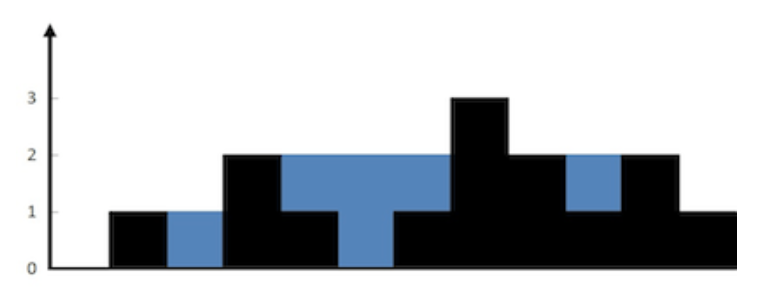
The above elevation map can be represented by array [0,1,0,2,1,0,1,3,2,1,2,1]. In this case, 6 unit of water is the total volume of Reservoir (水庫)
Note that: If you are using visual studio, add #pragma warning(disable:4996) in the first line so that you can use scanf on your local machine.
Input
N
S_1 S_2 ... S_N
Given an elvation map with the length of N ( 3 <= N < 3000) with each element S_i (0 <= S_i < 1000)
Output
Compute the total volume of Reservoir (水庫).(followed by an newline character at the end of output string)
Sample Input Download
Sample Output Download
Tags
Discuss
Description
Given a string of length n, print all permutation of the given string. and repetition of characters is allowed!.
There are few examples below:
Case1:
Input: A
output: A
Case2:
Input: AB
output: AA AB BA BB
Input
S
S: the input string ( 2 <= len(S)) < 7)
Note : the input string only contain alpha characters included upercase and lowercase.
Note : each element of input string is different.
Output
Ouput the permutation with repetition pattern (each output string followed by a newline characters)
Sample Input Download
Sample Output Download
Tags
Discuss
Description
Given a link list structure named Node.
typedef struct _Node {

    int data;

    struct _Node *next;

} Node;
In this problem, you need to implement five operation for the linked list.
func1: Node* createList(int *a, int size);
func2: void push_front(Node** head, int val);
func3: Node* copyList(Node* head);
func4: void deleteElementByIdx(Node** head, int idx);
func5: void SwapElementByIdx(Node** head, int idx1, int idx2);
func1: using an array to build the link list
func2: append the input value to the first element in the linked list
ex: origin linked list : [0, 1, 2, 3], when call the function push_front(&head, 5). the final linked list will be [5 ,0 ,1, 2, 3]
func3: copy the original link list (not directly to assign it)
func4: delete the element by its index (begin from 0)
ex: origin linked list : [0, 1, 2, 3], when call the function deleteElementByIdx(&head, 0). the final linked list will be [1,2,3]
note that: if the idx out of range. you should ignore the delete operation
func5: swap the element in linked list by given idx1 and idx2 (both begin from 0)
ex: origin linked list: [0, 1, 2, 3], when call the function SwapElementByIdx(&head, 0, 3). the final linked list will be [3, 1, 2, 0]
note that: if the idx1 or idx2 out of range, you should ignore the swap operation
Note: We guarantee that function 1, 3~5 will not operate on an empty list.
Input
T M
S1 .. SM
t1_command
...
tT_command
T: the number of command ( 0 <= T < 200)
M: the number of initial linked size (0 <= M <= 2000)
Si: the value of the initial array (0 <= Si <= 1000)
ti_command: the command description
(0: push_front, 1: clone, 2: delete, 3: swap)
Hint:
testcase1 : contain only createList operation
testcase2: contain only push_front operation
testcase3: contain createList , push_front, copyList operation
testcase4: contain createList , push_front , copyList operation, deleteElementByIdx
testcase5: contain all operation
Output
Output the element in linked list whenever the operation be called.