| # | Problem | Pass Rate (passed user / total user) |
|---|---|---|
| 11459 | Cheat Sheet |
|
| 12787 | Base64 Encoding |
|
| 12793 | Rolling Balls |
|
Description
Array.cpp
// overloaded assignment operator;
// const return avoids: ( a1 = a2 ) = a3
const Array &Array::operator=( const Array &right )
{
   if ( &right != this ) // avoid self-assignment
   {
      // for Arrays of different sizes, deallocate original
      // left-side Array, then allocate new left-side Array
      if ( size != right.size )
      {
         delete [] ptr; // release space
         size = right.size; // resize this object
         ptr = new int[ size ]; // create space for Array copy
      } // end inner if

      for ( size_t i = 0; i < size; ++i )
         ptr[ i ] = right.ptr[ i ]; // copy array into object
   } // end outer if

   return *this; // enables x = y = z, for example
} // end function operator=

// determine if two Arrays are equal and
// return true, otherwise return false
bool Array::operator==( const Array &right ) const
{
   if ( size != right.size )
      return false; // arrays of different number of elements

   for ( size_t i = 0; i < size; ++i )
      if ( ptr[ i ] != right.ptr[ i ] )
         return false; // Array contents are not equal

   return true; // Arrays are equal
} // end function operator==

// overloaded subscript operator for non-const Arrays;
// reference return creates a modifiable lvalue
int &Array::operator[]( int subscript )
{
   // check for subscript out-of-range error
   if ( subscript < 0 || subscript >= size )
      throw out_of_range( "Subscript out of range" );

   return ptr[ subscript ]; // reference return
} // end function operator[]

// overloaded subscript operator for const Arrays
// const reference return creates an rvalue
int Array::operator[]( int subscript ) const
{
   // check for subscript out-of-range error
   if ( subscript < 0 || subscript >= size )
      throw out_of_range( "Subscript out of range" );

   return ptr[ subscript ]; // returns copy of this element
} // end function operator[]

// overloaded input operator for class Array;
// inputs values for entire Array
istream &operator>>( istream &input, Array &a )
{
   for ( size_t i = 0; i < a.size; ++i )
      input >> a.ptr[ i ];

   return input; // enables cin >> x >> y;
} // end function

// overloaded output operator for class Array
ostream &operator<<( ostream &output, const Array &a )
{
   // output private ptr-based array
   for ( size_t i = 0; i < a.size; ++i )
   {
      output << setw( 12 ) << a.ptr[ i ];

      if ( ( i + 1 ) % 4 == 0 ) // 4 numbers per row of output
         output << endl;
   } // end for

   if ( a.size % 4 != 0 ) // end last line of output
      output << endl;

   return output; // enables cout << x << y;
} // end function operator<<
|
Inheritance type |
Public |
Protected |
Private |
|
Public data/ functions in the base class |
Public in the derived class |
Protected in the derived class |
Private in the derived class |
|
Protected data/ functions in the base class |
Protected in the derived class |
Protected in the derived class |
Private in the derived class |
|
Private data/fun in the base class |
Not accessible in the derived class |
Not accessible in the derived class |
Not accessible in the derived clas |
Polymorphism
In the base class
virtual void foo();
In the derived class
virtual void foo() override;
Abstract class and pure virtual function
virtual void foo() =0;
Prefix/postfix operators
complex &operator++(); // prefix
complex operator++(int); // postfix
Operator overloading
Binary operators
/*1.non-static member function */
complex operator+ (const complex&);
/* 2. non-member function */
friend complex operator* (const
complex&, const complex&);
Unitary operators
/*1.non-static member function */
complex operator-();
/*2. non-member function */
friend complex operator~(const complex&);
Inheritance
class A {
// A is a base class }
class B: public A {
// B inherits A.
// B is a derived class}
Dynamic allocation
int *ptr = new int;
delete ptr;
int *ptr = new int[100];
delete [] ptr;
String object
#include<string>
using namespace std;
...
string str1 = "Hello";
string str2 = "World";
Standard C++ Library - <string>
|
operator[] |
For string a, a[pos]: Return a reference to the character at position pos in the string a. |
|
operator+= |
Append additional characters at the end of current string. |
|
operator+ |
Concatenate strings. |
|
operator< |
Compare string values. For string a and b, a < b: if a is in front of b in dictionary order, return 1, else return 0. |
|
operator> |
Compare string values. For string a and b, a > b: if a is in back of b in dictionary order, return 1, else return 0. |
|
operator== |
Compare string values. For string a and b, a == b: if equal, return 1, else return 0; |
|
operator!= |
Compare string values. For string a and string b, a != b: if not equal, return 1, else return 0; |
|
compare() |
Compare string. For string a and b, a.compare(b): if equal, return 0. If string a is in front of string b in dictionary order, return -1. If string a is in back of string b in dictionary order, return 1. |
|
length() |
Return length of string. |
|
swap() |
Swap string values. |
|
push_back() |
For string a, a.push_back(c): append character c to the end of the string a, increasing its length by one. |
Standard C++ Library - <sstream>
|
operator<< |
Retrieves as many characters as possible into the stream. |
|
operator>> |
Extracts as many characters as possible from the stream. |
|
str |
Returns a string object with a copy of the current contents of the stream. |
For example(1):
stringstream ss{“Hello”}; // constructor
string str = ss.str(); // a = “Hello”
For example(2):
stringstream ss;
ss<<”75”;
ss<<”76”;
int num;
ss>>num; // num = 7576
Input
Output
Sample Input Download
Sample Output Download
Tags
Discuss
Description
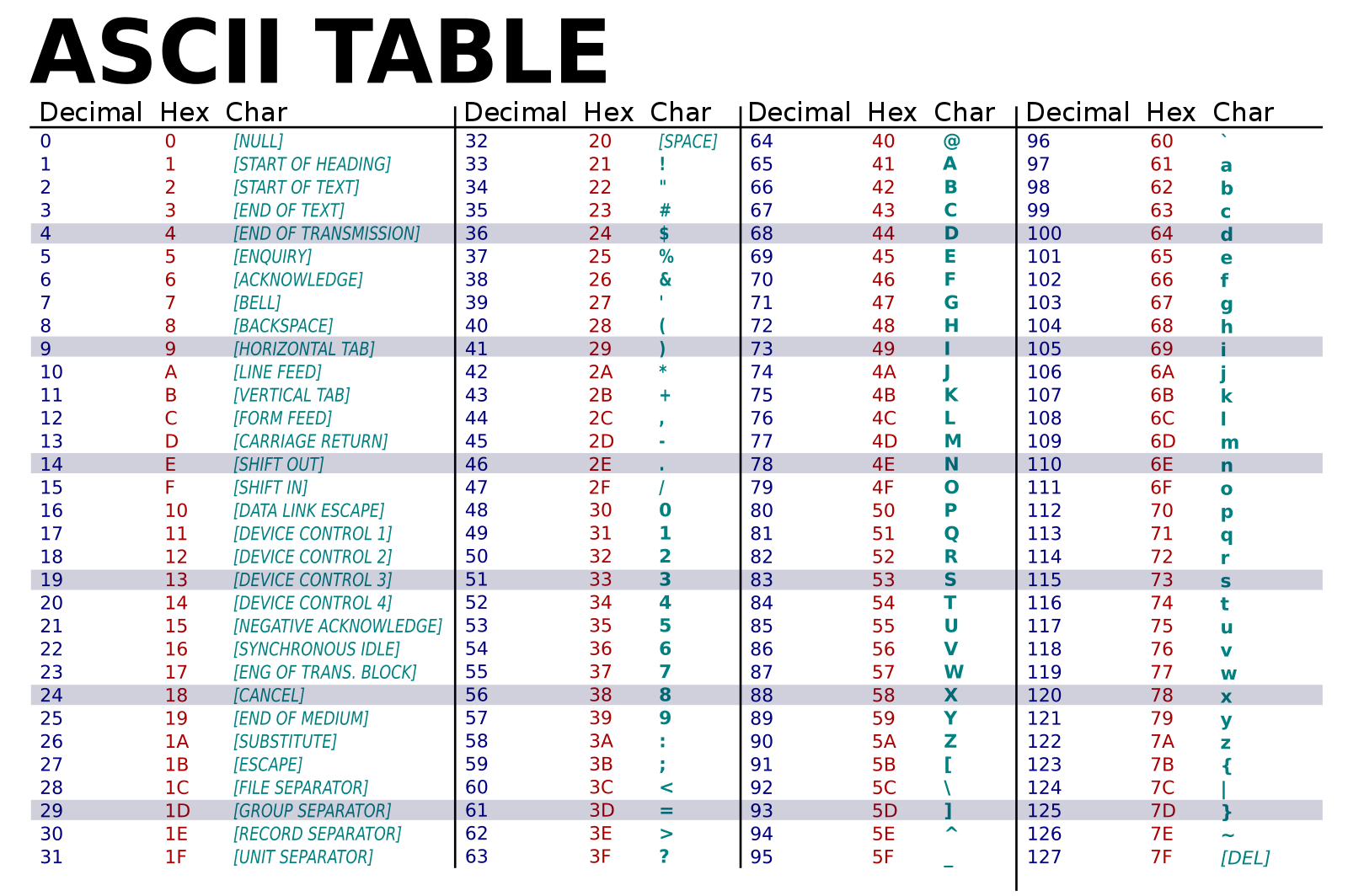
In computer science, Base64 is a binary-to-text encoding method. Here is how Base64 encoding works.
Given a string that contains ASCII characters:
- First, you need to turn each character to its ASCII number then to its 8-bits binary number,
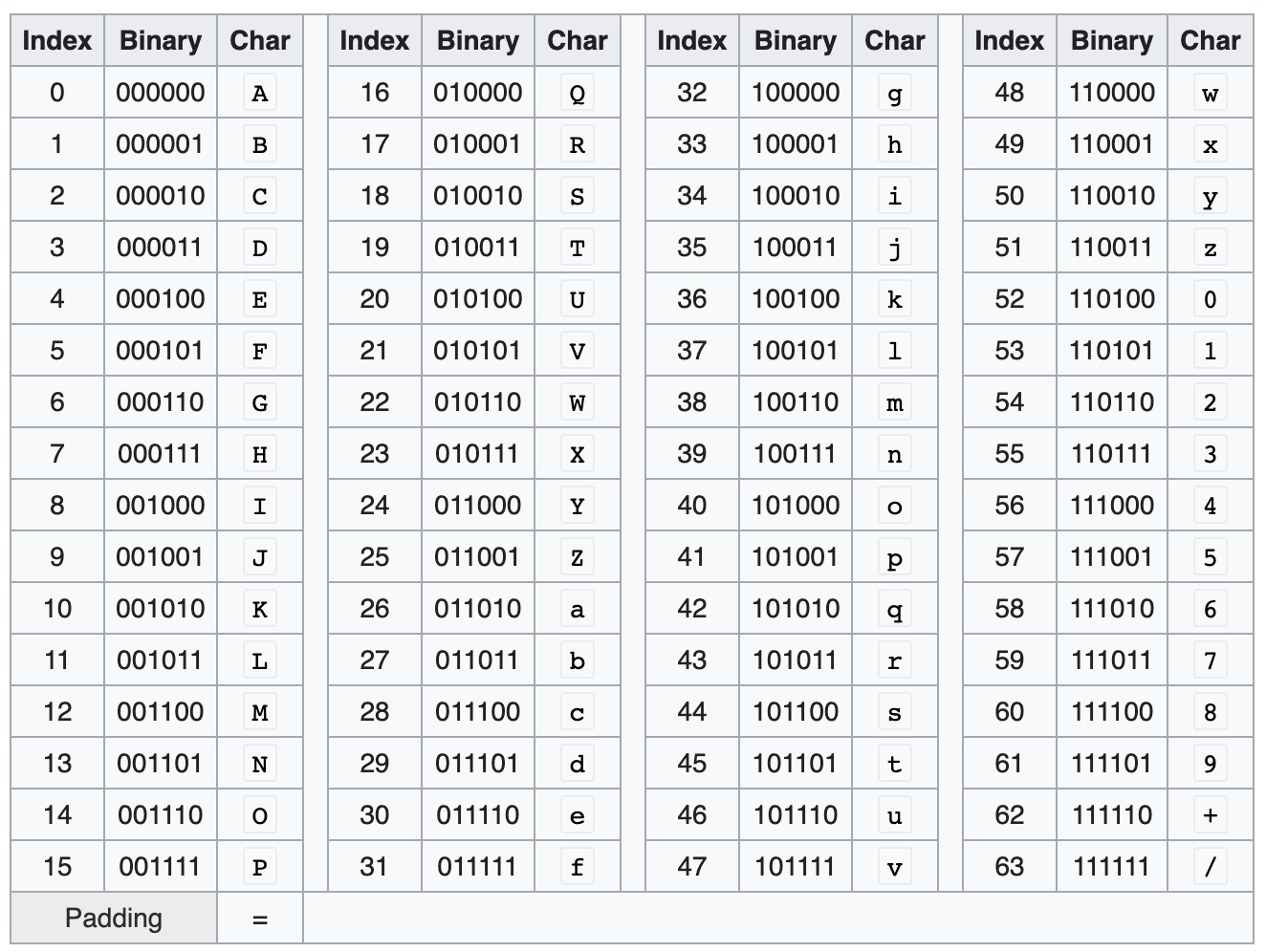
- Second, connect all the binary numbers, from the first binary, and replace every 6 bits by its corresponding Base64 character, where such mapping is provided in the Base64 index table below.
- Last, if the total length of all the binary numbers (in terms of bits) is not a multiple of 6, add zero until the total length is a multiple of 6, and for every 2 zero you add, add a '=' character to your encoded string.
ouo.
The ASCII code table is as follows:
The Base64 index table is as follows: (From WIKI)
Sample Input 1:
Turn the string "Man" to ASCII numbers:
M = 77, a = 97, n = 110.
Turn ASCII numbers to 8-bits binary numbers:
77 = 01001101, 97 = 01100001, 110 = 01101110,
010011 / 010110 / 000101 / 101110
Replace every 6 bits by the corresponding character as the table above:
010011 = T / 010110 = W / 000101 = F / 101110 = u
Base64 encoding of "Man" is "TWFu"
Sample Input 2:
Turn the string "Ma" to ASCII numbers:
M = 77, a = 97.
Turn ASCII numbers to 8-bits binary numbers:
77 = 01001101, 97 = 01100001.
010011 / 010110 / 0001
The length is not a multiple of 6, add zero until it becomes a multiple of 6. So we add 2 zero:
010011 / 010110 / 000100
Replace every 6 bits by the corresponding character as the table above:
010011 = T / 010110 = W / 000100 = E
For every 2 zero you add, add 1 '=' to the Base64 encoding result. So we add 1 '=':
Base64 encoding of "Ma" is "TWE="
Sample Input 3:
Turn the string "M" to ASCII numbers:
M = 77.
Turn ASCII numbers to 8-bits binary numbers:
77 = 01001101.
010011 / 01
The length is not a multiple of 6, add zero until it becomes a multiple of 6. So we add 4 zero:
010011 / 010000
Replace every 6 bits by the corresponding character as the table above:
010011 = T / 010000 = Q
For every 2 zero you add, add 1 '=' to the Base64 encoding result. So we add 2 '=':
Base64 encoding of "M" is "TQ=="
The class inheritance hierarchy of this problem is given below:
class Codec {
protected:
  bool encoded;
  string code_str;
public:
  Codec(string& code_str): code_str(code_str), encoded(false) {}
  virtual void encode() = 0;
  virtual void decode() = 0;
  virtual void print(ostream& os) const = 0;
  virtual bool is_encoded() const = 0;
};

class Base64Codec: public Codec {
private:
  // Given 6-bits binary number, return with the Base64 encode character
  char encodeCharacter(int binaryNumber) const;
public:
  // Inherit from base class
  Base64Codec(string& code_str): Codec(code_str) {}
  // TODO: Encode the code_str
  void encode() override;
  // Decode the code_str
  void decode() override;
  // Print the code_str
  void print(ostream& os) const override;
  // Get code_str status
  bool is_encoded() const override;
};
In this problem, you only need to implement the member function encode() of class Base64Codec.
Note:
1. We have implemented the encodeCharacter(int binaryNumber) function in class Base64Codec for you, whose details are further explained below:
Given a binaryNumber in decimal, representing a 6-bits binary number, encodeCharacter() returns the corresponding character to Base64 encoding.
Example:
binaryNumber = 19(decimal) = 010011(binary),
encodeCharacter(binaryNumber) returns character 'T'
2. You should choose 'C++11' on submission.
Input
The input contains 1 line: a string S.
The string will only contain characters A~Z, a~z, 0~9, space, comma(',') and period('.')
It is guaranteed that:
1 <= |S| <= 2000
Output
The output contains only 1 line: the Base64 encoding of the given string.
With a new line character after your output.
Sample Input Download
Sample Output Download
Partial Judge Code
12787.cppPartial Judge Header
12787.hTags
Discuss
Description
Tim Brown published a game “Rolling Balls”.
In this game, the player’s target is to roll balls with different colors into a moving bag as more as possible. A ball can be represented by its color (r, g, b).
Unfortunately, some unscrupulous players always want to cheat in the game.
Therefore, Tim hires you to make a cheating detection system CDSystem, which monitors and simulates the game progress to figure out any impossible data modification.
Your task is to complete a data structure called MultiSet, which can be implemented using Binary Search Tree as MultiSet_Tree.
In this problem, a MultiSet is used to represent a moving bag, into which balls with different colors can be rolled.
MultiSet
MultiSet is a data structure that supports the following operations:
- Insert(x): insert an element x into the set
- Delete(x): remove one element x from the set if there’re some x in the set
- Search(x): return the amount of x in the set
Example:
The MultiSet MS={a,b,y,y}. Search(a) = 1, Search(y) = 2, Search(x) = 0.
After Insert(x) and Delete(y), MS={a,b,x,y}. Then, Search(y) = 1, Search(x) = 1.
MultiSet_Tree
MultiSet_Tree is MultiSet implemented using Binary Search Tree, where the tree nodes store the elements and their amounts in the set. The Insert and Delete operations of MultiSet_Tree can be further explained as follows:
- Insert(x):
- Delete(x):
MultiSet_Tree Node Greatness/Smallness: Colors of Balls
In this problem, a MultiSet_Tree node represents a specific ball color (r, g, b).
To implement Binary Search Tree, the greatness/smallness (<, >, ==) between two colors is determined sequentially below:
- Compare the r values of the two colors.
- If the r values equal, compare the g values of the two colors.
- If the g values equal, compare the b values of the two colors.
- If all the r, g, b values are the same, the two colors are equal.
In this partial judge problem, you have to complete:
Color: operators<,>,==,=, where the assignment operator=is needed when you make/modify MultiSet_Tree Nodes.Node: Constructor, DestructorMultiSet_Tree: Constructor, Destructor, Insert, Delete, Search
More Hints on Case 3 of MultiSet_Tree Delete Operation
Supposing Node x with amount ==1 is to be deleted, three possible sub-cases should be considered:
- Node x has 2 children: replace x by the Node with the largest key among the keys less than x.
- Node x has 1 child: replace x by its child Node
- Node x has no child: replace x by
NULL.


Input
The first line gives the number of test cases T.
Each case consists of one integer N and N lines of operations.
Each operation opi is with one of the following formats:
- "+ r g b": Roll a ball with color (r,g,b) into the bag.
- "- r g b": Take away a ball with color (r,g,b) from the bag. If there’s no such ball, just do nothing.
- "? r g b": Print the number of balls with color (r,g,b).
- "PrintSet": Print all nodes (key, amount, level) of
MultiSet_Treein the level-order traversal, where the key is color (r, g, b).
It’s guaranteed that:
- 1 ≤ T ≤ 200
- 0 ≤ N ≤ 5,000
- 0 ≤ r, g, b ≤ 255
- 1st testcase = sample input
- 2nd,3rd testcases only contain operations “+ r g b” , "? r g b", "PrintSet"
- 4~6th testcases contain operations “+ r g b”, “? r g b”, "- r g b", "PrintSet"
Output
For each test case, output one line with “Case #x:”, where x is the test case number (starting from 1).
Then print the result of each “? r g b”/“PrintSet” for one line.
Remember '\n' for the end of each line.