| # | Problem | Pass Rate (passed user / total user) |
|---|---|---|
| 12993 | Patrick Star carpet |
|
| 12994 | DP Slayer (easy version) |
|
| 12995 | DP Slayer (hard version) |
|
Description
Patrick is a student in the prgramming course. After he solved the problem 12964 - Sierpiński carpet, he creates a pattern similar to Sierpinski carpet and name it as Patrick Star carpet because his name is Patrick and he is a star fish.
Patrick Star carpet is a square that its side length is the power of 3 and all the grids are coloerd white. The construction is described as follow.
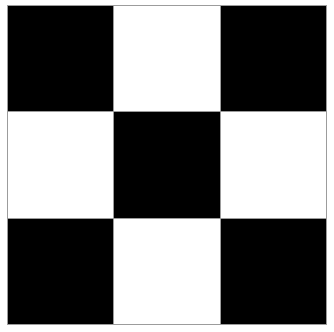
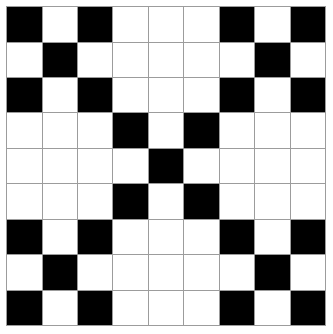
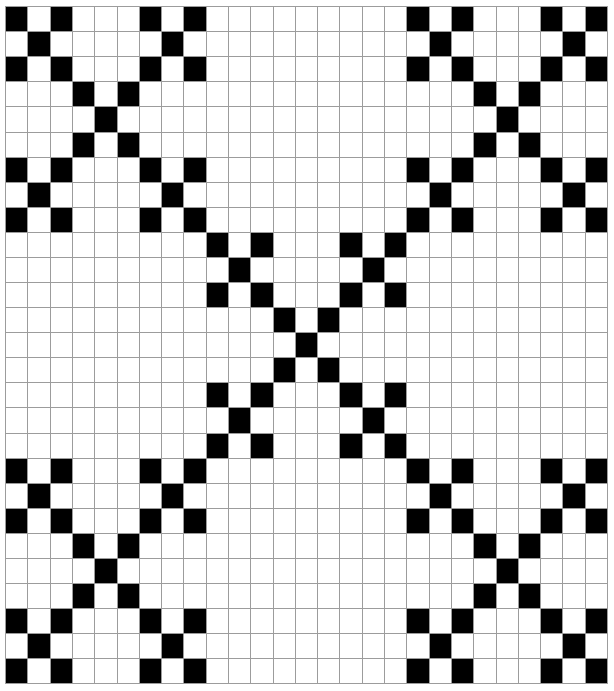
For a Patrick Star carpet that its side length is three, color the 4 corner and the center one with black. For a Patrick star carpet with side length greater than 3, cut it into 9 congruent subsquares in a 3-by-3 grid, and then apply the same procedure to the subsquare at the four corner and the center, that is, put a Patrick Star carpet that its side length is the one-third of the original side length in the subsquares at the four corner and the center.
For instance, the following figures are the Patrick Star carpet with side length 3 and 9.
The following fugure is the Patrick Star carpet with side length 27.
Input
Input contains only one line with single integer n (1 <= n <= 7).
Output
Output the Patrick Star carpet with side length 3n and use '.' to represent white, '#' to represent black.
Remember to add a newline character at the end of line.
Sample Input Download
Sample Output Download
Tags
Discuss
Description
The only difference between easy and hard versions are constraints on q, ai and bi.
There are n items. The weight and value of the i-th item are wi and vi separately.
The total weight of items you can take away is at most m.
There are q queries. In each query, what is the maximum sum of value you can get if you must take the ai-th item and bi-th item?
Input
The first line contains two integers n, m (2 ≤ n ≤ 20, 0 ≤ m ≤ 109) – the number of items and the totol weight you can take away.
Then n lines follow. The i+1-th line contains two integers wi, vi (0 ≤ wi, vi ≤ 109) – the weight and value of the i-th item.
Next line contains one integer q (q = 1) – the times of the queries.
Then q lines follow. The i+n+2-th line contains two integers ai, bi (1 ≤ ai < bi ≤ n) – the two items you must take in the i-th query. It is guaranteed that the weight and value of both the ai-th item and the bi-th item must be zero.
Output
For each query output the maximum sum of value you can get(if there is no legal plan, output 0 instead) and then output a newline('\n').
Sample Input Download
Sample Output Download
Tags
Discuss
Description
The only difference between easy and hard versions are constraints on q, ai and bi.
There are n items. The weight and value of the i-th item are wi and vi separately.
The total weight of items you can take away is at most m.
There are q queries. In each query, what is the maximum sum of value you can get if you must take the ai-th item and bi-th item?
Input
The first line contains two integers n, m (2 ≤ n ≤ 20, 0 ≤ m ≤ 109) – the number of items and the totol weight you can take away.
Then n lines follow. The i+1-th line contains two integers wi, vi (0 ≤ wi, vi ≤ 109) – the weight and value of the i-th item.
Next line contains one integer q (1 ≤ q ≤ 105) – the times of the queries.
Then q lines follow. The i+n+2-th line contains two integers ai, bi (1 ≤ ai < bi ≤ n) – the two items you must take in the i-th query.
Output
For each query output the maximum sum of value you can get(if there is no legal plan, output 0 instead) and then output a newline('\n').