| # | Problem | Pass Rate (passed user / total user) |
|---|---|---|
| 10945 | Increasing linked list |
|
| 10947 | delete linked list |
|
| 10948 | Delete linked list test |
|
| 10949 | Find Maximum in a binary tree |
|
| 10950 | Tree Traversal |
|
| 10954 | Prefix to truth table |
|
| 10955 | Prefix to truth table 2 |
|
| 10961 | Prefix expression |
|
| 10962 | Find Sum in a binary tree |
|
| 10966 | Infix to syntax tree |
|
| 10969 | Attachment |
|
| 10972 | Remove unnecessary parentheses |
|
| 10980 | practice Josephus |
|
Description
Given a link list structure named Node.
typedef struct _Node {
int data;
struct _Node *next;
} Node;
Use this structure to implement a increasing integer link list.
You will be provided with main.c and function.h, and asked to implement function.c.
For OJ submission:
Step 1. Submit only your function.c into the submission block. (Please choose c compiler)
Step 2. Check the results and debug your program if necessary.
main.c
function.h
Input
A non negative integer data per rows, if input is smaller then 0 then exit the while loop and exit the program.
Output
Please follow the output of program
Sample Input Download
Sample Output Download
Partial Judge Code
10945.cPartial Judge Header
10945.hTags
Discuss
Description
This problem will give you a sequence of positive integers. Use this sequence to create a linked list to store those integers. Next, the problem will give you another sequence of positive integers, p0, p1,…pk-1. Delete the nodes in the position at p0, p1, …pk-1 of the linked list, where 1<=p0<p1<…pk-1<=N. If the node is not existing,do nothing. And show the final results.
For example, if the first sequence is 1, 2, 3, 4, 5, 6,7, a linked list is created as
If the second sequence is 1, 1, 4, do the follows.
After p1=1, the list becomes
because the first node is 1. After p2 = 1, the list becomes
because the first node is 2. After p3 = 4, the list becomes
because the fourth node is 6.
The framework of the program is provided.
- Create a linked list from the input (createList)
- while there are still some data pi
- read in pi
- delete node at pi (deleteNode)
- print the remaining list (printList)
- free the list (freeList)
You will be provided with main.c and function.h. main.c contains the implementation of function printList, and freeList, and function.h contains the definition of node and the interface of createList(&head) and deleteNode(&head, pi). You only need to implement createList(&head) and deleteNode(&head, pi) in function.c, in which head is the head of the linked list, and pi is the node at pi to be deleted.
You will be provided with main.c and function.h, and asked to implement function.c.
For OJ submission:
Step 1. Submit only your function.c into the submission block. (Please choose c compiler)
Step 2. Check the results and debug your program if necessary.
main.c
function.h
Input
The input contains 2 sequence of positive integers as the linklist and the order, except the last one, which is -1, indicating the end of the sequence.
Output
The output contains the sequence of resulting linklist.
Sample Input Download
Sample Output Download
Partial Judge Code
10947.cPartial Judge Header
10947.hTags
Discuss
Description
This problem will give you a sequence of positive integers. Use this sequence to create a linked list to store those integers. Next, the problem will give you another sequence of positive integers, p0, p1,…pk-1. Delete the nodes that the data is equal to one of p0, p1, …pk-1 of the linked list, where 1<=p0<p1<…pk-1<=N. If the node is not existing,do nothing. And show the final results.
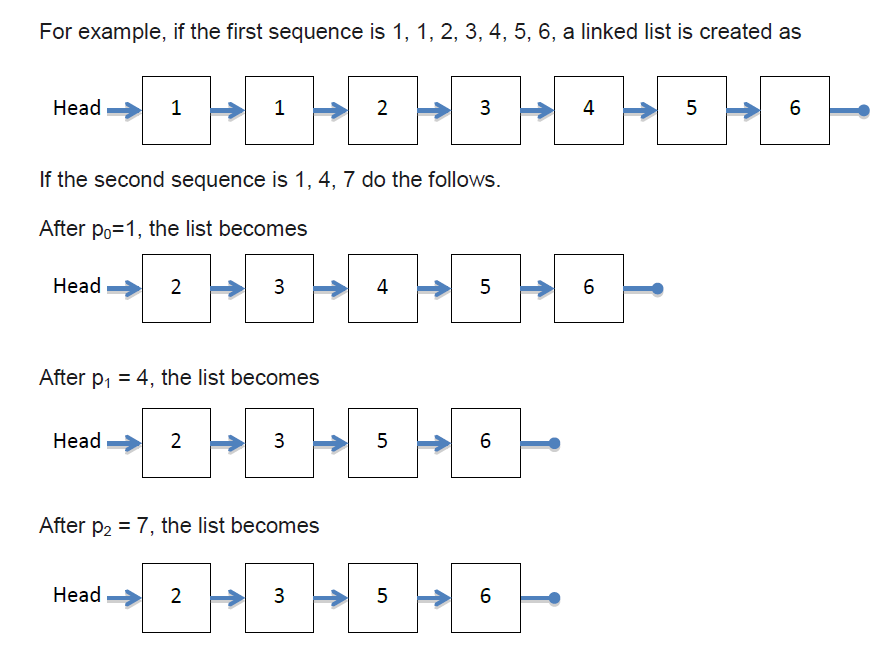
The framework of the program is provided.
- Create a linked list from the input (createList)
- while there are still some data pi
- read in pi
- delete node that data is equal to pi (deleteNode)
- print the remaining list (printList)
- free the list (freeList)
You will be provided with main.c and function.h. main.c contains the implementation of function printList, and freeList, and function.h contains the definition of node and the interface of createList() and deleteNode(&head, pi). You only need to implement createList() and deleteNode(&head, pi) in function.c, in which head is the head of the linked list, and pi is the data of the node to be deleted.
For OJ submission, you only need to submit your createList and deleteNode implementation to the submission block. (Choose c compiler)
Below is the partial code for main.c
main.c
function.h
Input
The input contains 2 sequences of positive integers. The first sequence is to create a linked list of integers, and the second sequence is the nodes to be deleted. Each sequence is ended by -1.
Output
The output contains the sequence of resulting linklist.
Sample Input Download
Sample Output Download
Partial Judge Code
10948.cPartial Judge Header
10948.hTags
Discuss
Description
In this assignment, you have to find the maximum value in a binary tree.
The idea of solving this problem is to find the maximum value in the left sub-tree, find maximum in the right sub-tree, compare it with the root data and select the one that gives the maximum value. Like this,
max{root, max of left subtree, max of right subtree}
main.c
function.h
All other function are provided. You only need to implement the function maxValue,
int maxValue(Node *root)
which gets the pointer of the tree root and returns the maximum value.
You will be provided with main.c and function.h, and asked to implement function.c.
For OJ submission:
Step 1. Submit only your maxValue into the submission block. (Please choose C compiler)
Step 2. Check the results and debug your program if necessary.
Input
The first line will have a number N with the number of tree node, second and third line are inorder and preorder of a tree respectively.
Notice that all the values are different.
Output
The maximum of a binary tree.
Sample Input Download
Sample Output Download
Partial Judge Code
10949.cPartial Judge Header
10949.hTags
Discuss
Description
Given a binary tree, print the inorder and postorder of the tree.
There are three common ways to traverse a binary tree recursively: inorder, preorder, and postorder. Each way contains three steps:
- Visit the root (V)
- Traverse the left subtree recursively (L)
- Traverse the right subtree recursively (R)
The difference of the three ways is the order of steps, inorder is LVR, preorder is VLR, and postorder is LRV. For example, the three traversal sequences of the tree below are as follows:
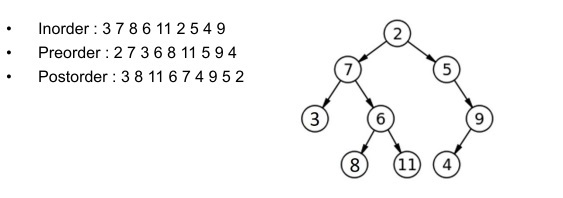
This problem will give you the inorder and preorder sequences to build a tree, and you have to write two recursive functions to print the inorder and postorder of the tree.
You will be provided with main.c and function.h. main.c contains the implementation of functions which build a tree by the inorder and preorder, and function.h contains the definition of tree node. You only need to implement inorder(Node *root) and postorder(Node *root) in function.c.
For OJ submission:
Step 1. Submit only your function.c into the submission block.(Please choose C compiler)
Step 2. Check the results and debug your program if necessary.
main.c
function.h
Input
The input contains three lines. The first line is the number of nodes in the tree. The second line is the inorder and the third line is the preorder of the tree.
Output
The output contains two sequences of integers. The first sequence is the inorder and the second sequence is the postorder of the tree.
Notice that there is a space after every integer.
Sample Input Download
Sample Output Download
Partial Judge Code
10950.cPartial Judge Header
10950.hTags
Discuss
Description
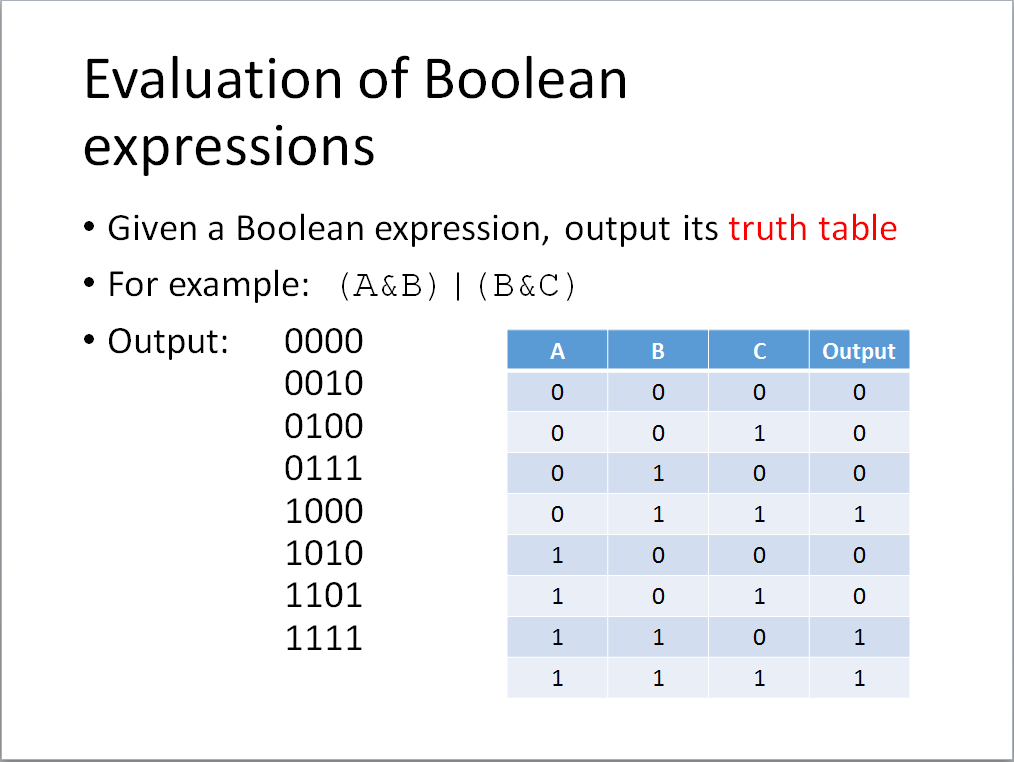
Give a prefix Boolean expression, which only has at most 4 variables ‘A’, ‘B’, ‘C’, and ‘D’, and 2 operators, AND ‘&’ and OR ‘|’, print its truth table.
For example, if input is "|&AC|AB", then result will be
A B C D output
0 0 0 0 0
0 0 0 1 0
0 0 1 0 0
0 0 1 1 0
0 1 0 0 1
0 1 0 1 1
0 1 1 0 1
0 1 1 1 1
1 0 0 0 1
1 0 0 1 1
1 0 1 0 1
1 0 1 1 1
1 1 0 0 1
1 1 0 1 1
1 1 1 0 1
1 1 1 1 1
Input
The input contains a sequences of prefix expression. It only has at most 4 variables ‘A’, ‘B’, ‘C’, and ‘D’, and 2 operators, AND ‘&’ and OR ‘|’. The length of prefix expression is shorter than 30.
Output
It has 5 variables 'A', 'B', 'C', 'D', and output, each variable is separated by a space.
Sample Input Download
Sample Output Download
Tags
Discuss
Description
Give a prefix Boolean expression, which only has at most 4 variables ‘A’, ‘B’, ‘C’, and ‘D’, and 2 operators, AND ‘&’ and OR ‘|’, print its truth table which output equal to 1.
For example, if input is "&|AB|CA", then result will be
A B C D output
0 1 1 0 1
0 1 1 1 1
1 0 0 0 1
1 0 0 1 1
1 0 1 0 1
1 0 1 1 1
1 1 0 0 1
1 1 0 1 1
1 1 1 0 1
1 1 1 1 1
Input
The input contains a sequences of prefix expression. It only has at most 4 variables ‘A’, ‘B’, ‘C’, and ‘D’, and 2 operators, AND ‘&’ and OR ‘|’. The length of prefix expression is shorter than 30.
Output
It has 4 variables 'A', 'B', 'C', 'D', and output, each variable is separated by a space.
Sample Input Download
Sample Output Download
Tags
Discuss
Description
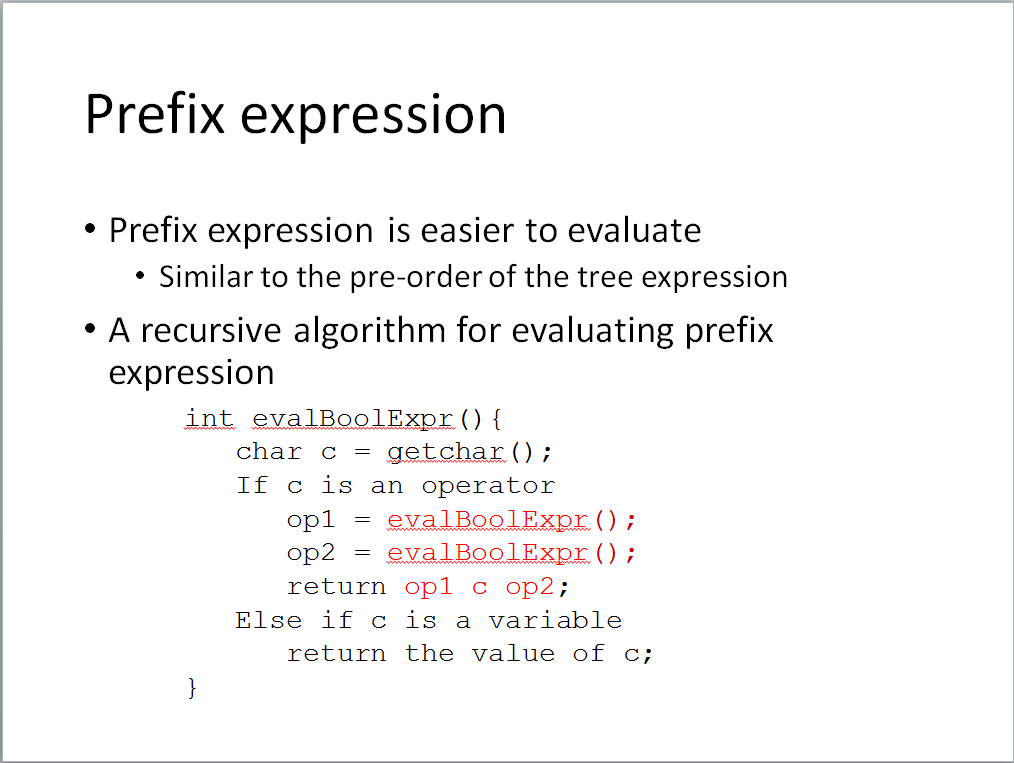
Give a prefix expression, which only has 2 operators, ‘+’ and ‘-’,and positive integers. Print the result.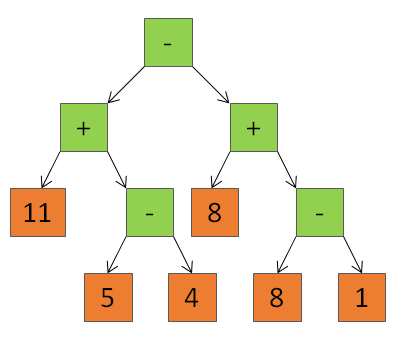
Input
The input contains a sequences of prefix expression. It contains operators, ‘+’ and ‘-’,and positive integers separated by a space. Expression is ended by 0. (0 is not the element.)
Output
The output is the result of the expression. (Without a newline symbol)
Sample Input Download
Sample Output Download
Tags
Discuss
Description
Given a binary tree, print the sum of nodes in the tree.
This problem will give you the inorder and preorder sequences to build a tree, and you have to write a function to count the sum of nodes in the tree. To solve this problem, you can write a recursive function to traverse the tree and sum up the data of nodes.
You will be provided with main.c and function.h. main.c contains the implementation of functions which build a tree by the inorder and preorder, and function.h contains the definition of tree node. You only need to implement Sum(Node *root) and print the sum in function.c.
For OJ submission:
Step 1. Submit only your function.c into the submission block.(Please choose C compiler)
Step 2. Check the results and debug your program if necessary.
main.c
function.h
Input
The input contains three lines. The first line is the number of nodes in the tree. The second line is the inorder and the third line is the preorder of the tree.
Output
The output is the sum of nodes in the tree.
Sample Input Download
Sample Output Download
Partial Judge Code
10962.cPartial Judge Header
10962.hTags
Discuss
Description
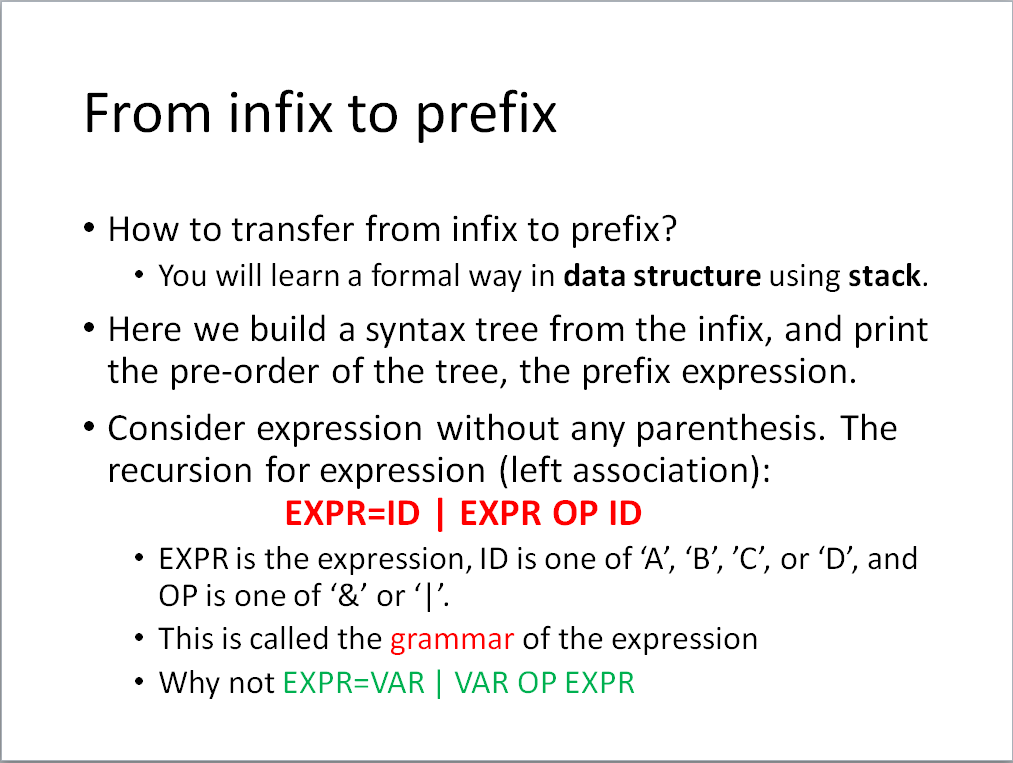
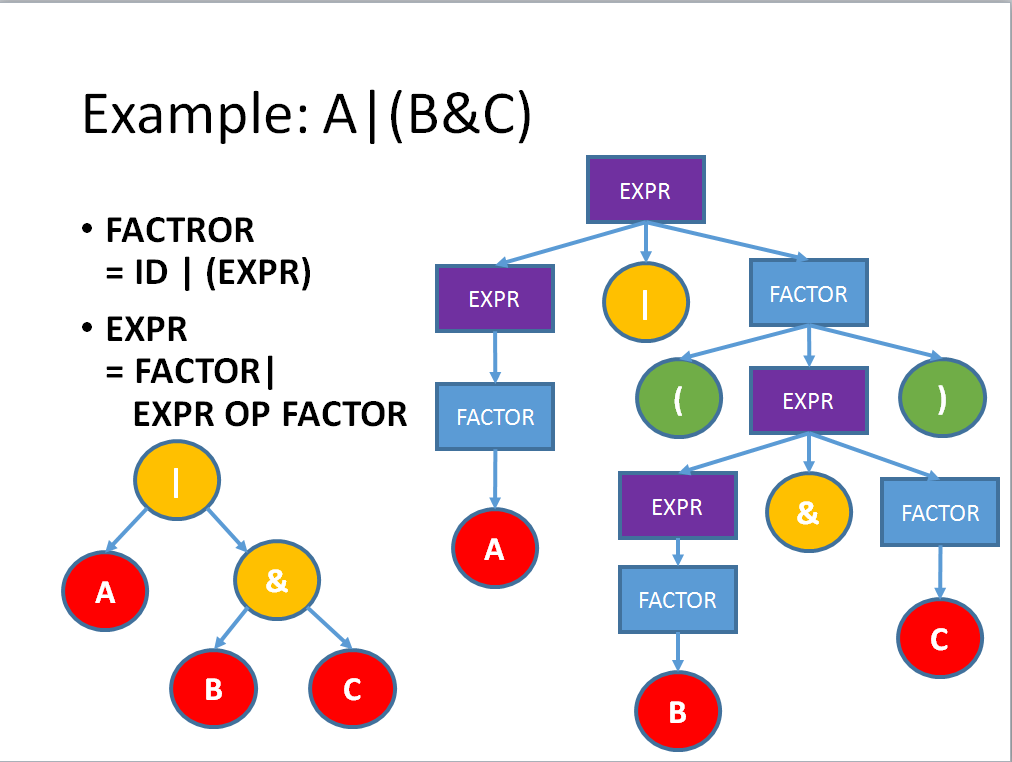
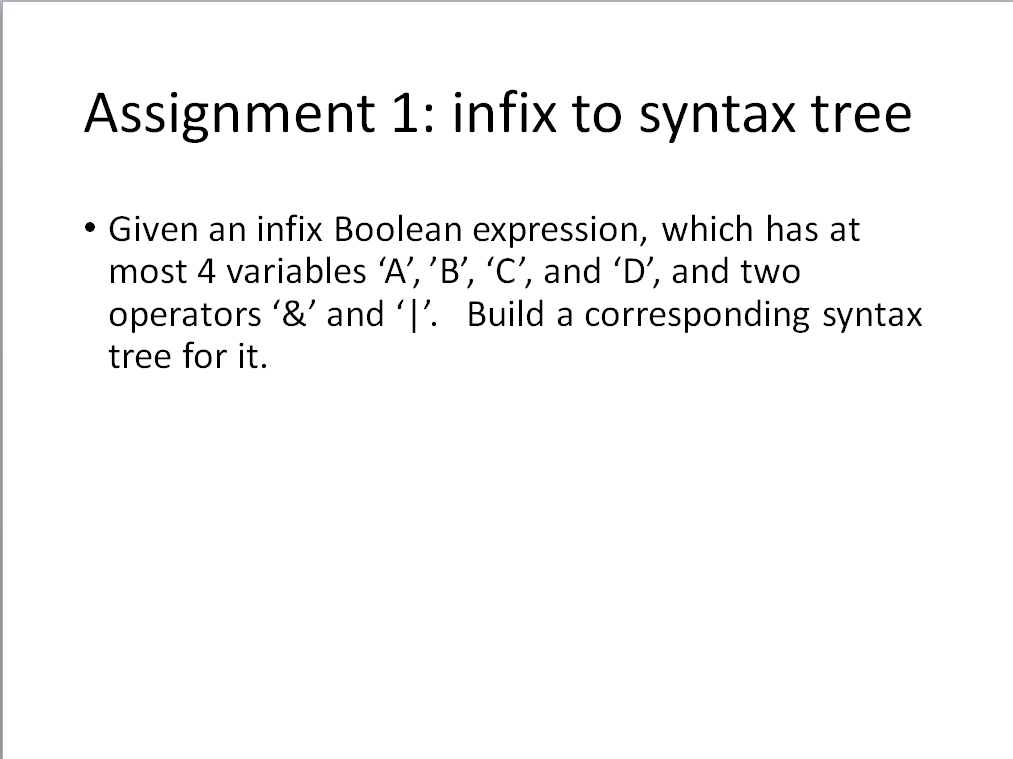
Given an infix Boolean expression with parentheses, which has at most 4 variables ‘A’, ’B’, ‘C’, and ‘D’, and two operators ‘&’ and ‘|’. Build a corresponding syntax tree for it.
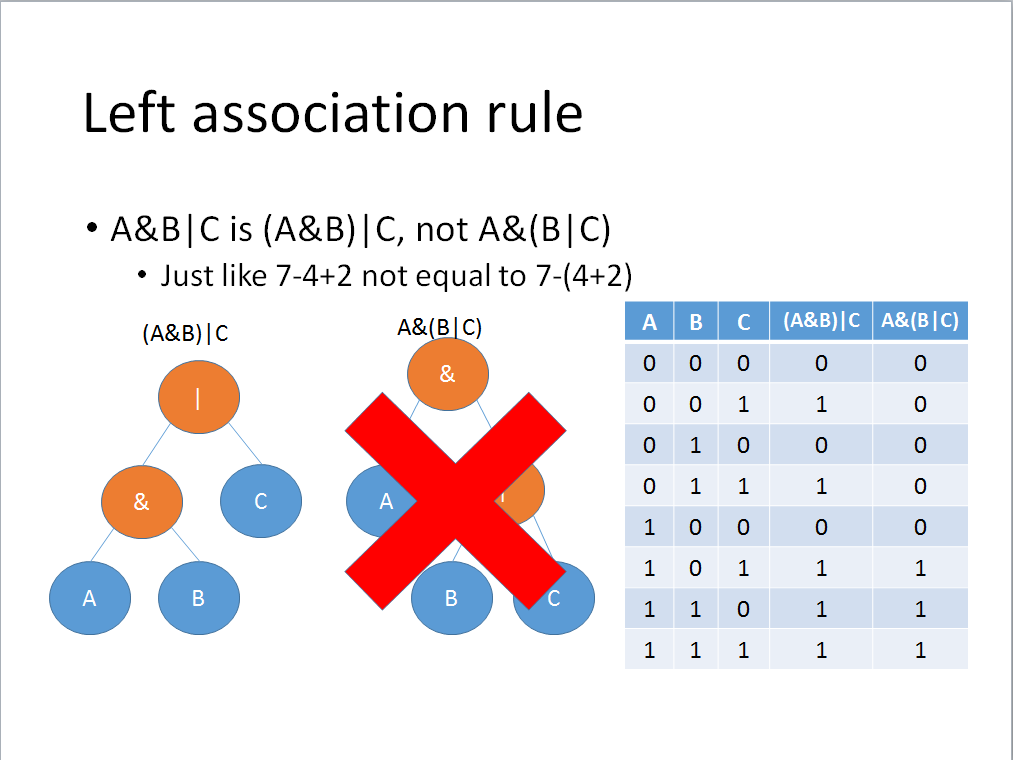
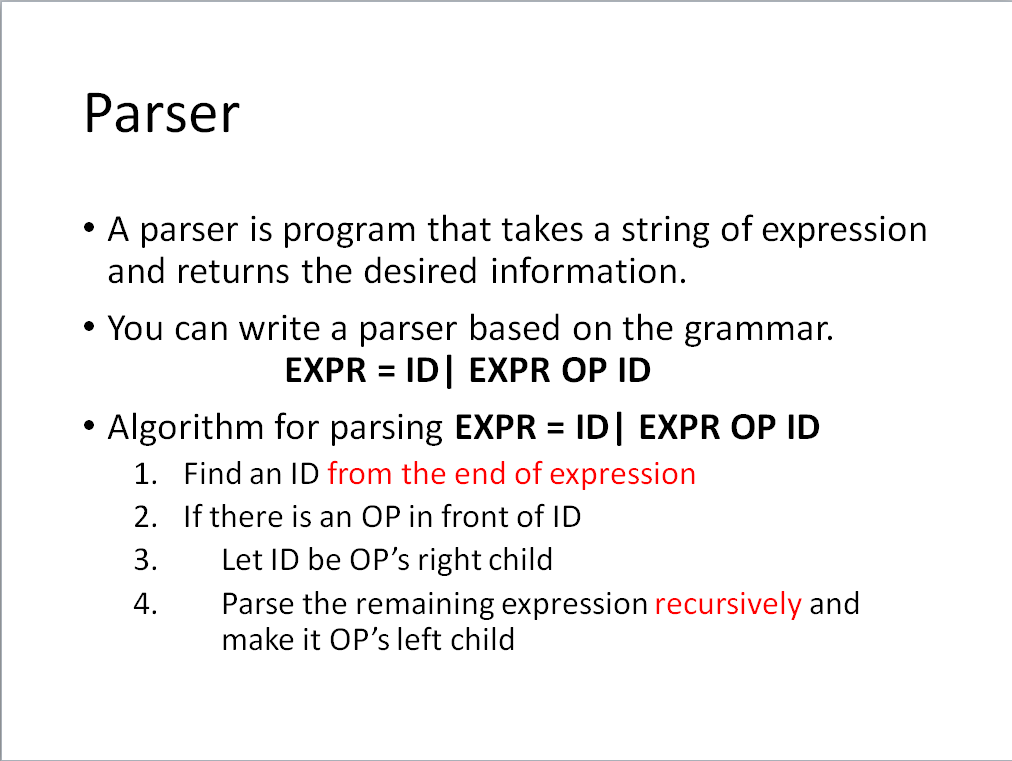
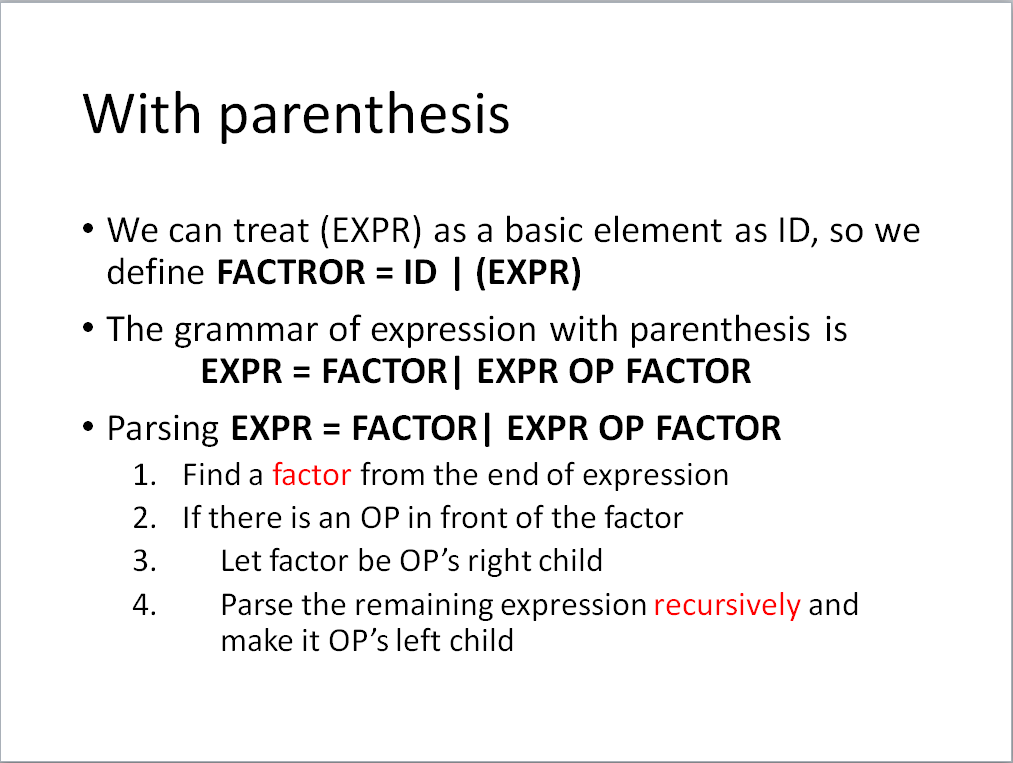
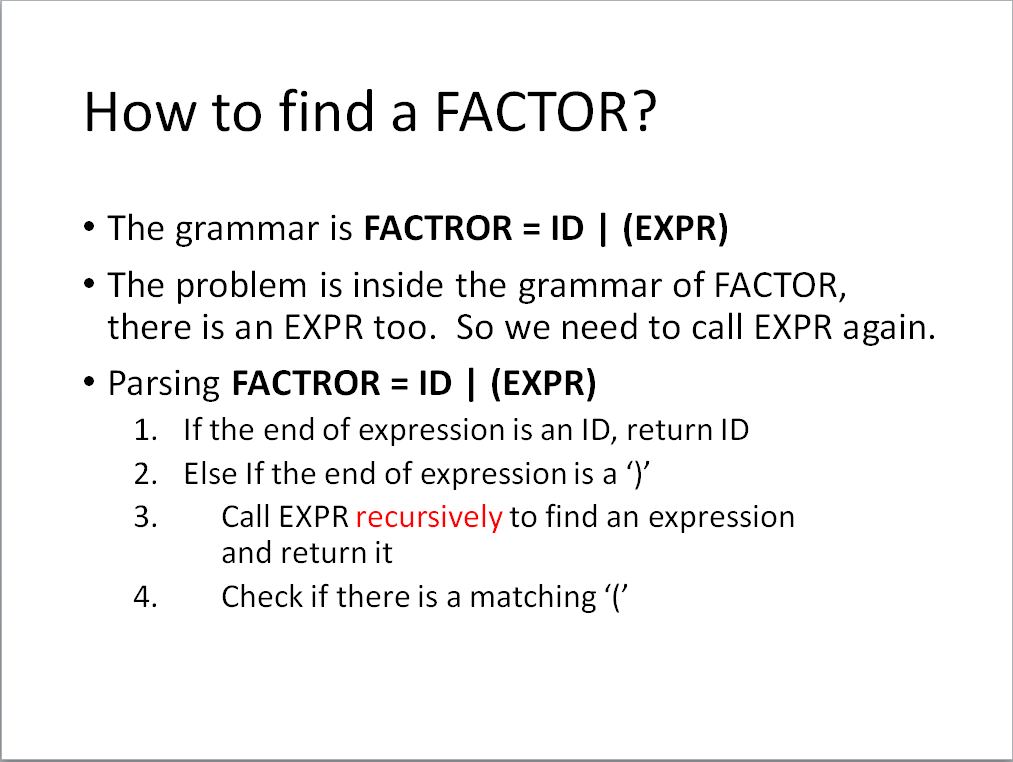
To parse the infix expression with parentheses, use the grammar below.
EXPR = FACTOR | EXPR OP FACTOR
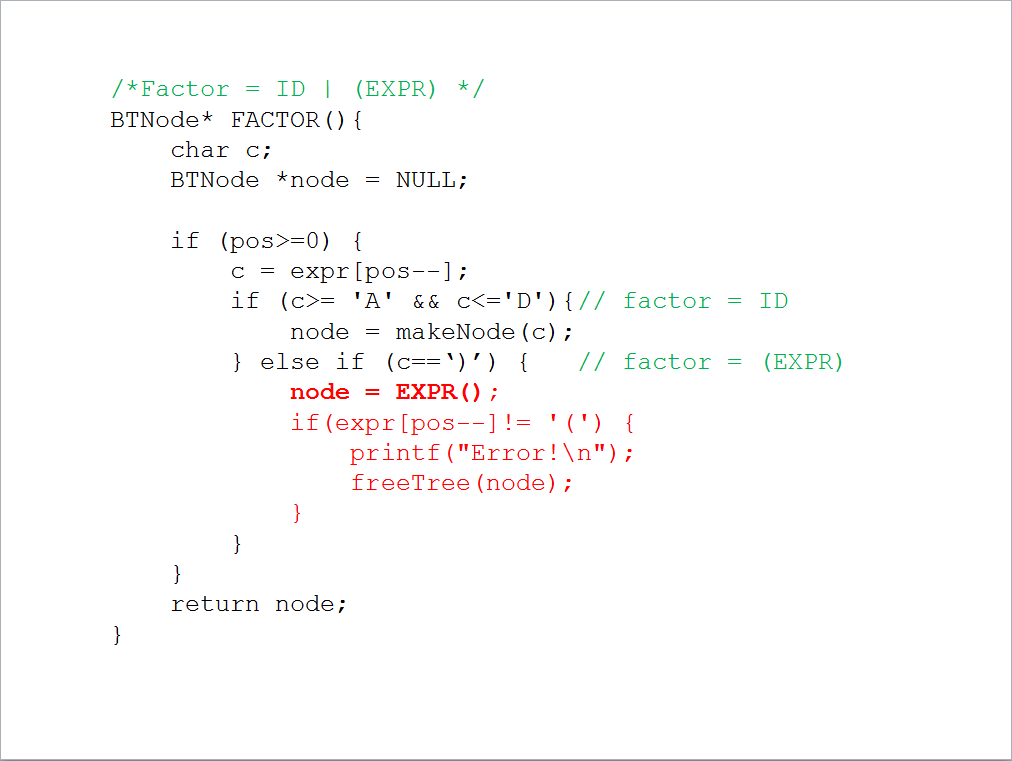
FACTOR = ID | (EXPR)
EXPR is the expression, ID is one of ‘A’, ‘B’, ’C’, or ‘D’, and OP is one of ‘&’ or ‘|’.
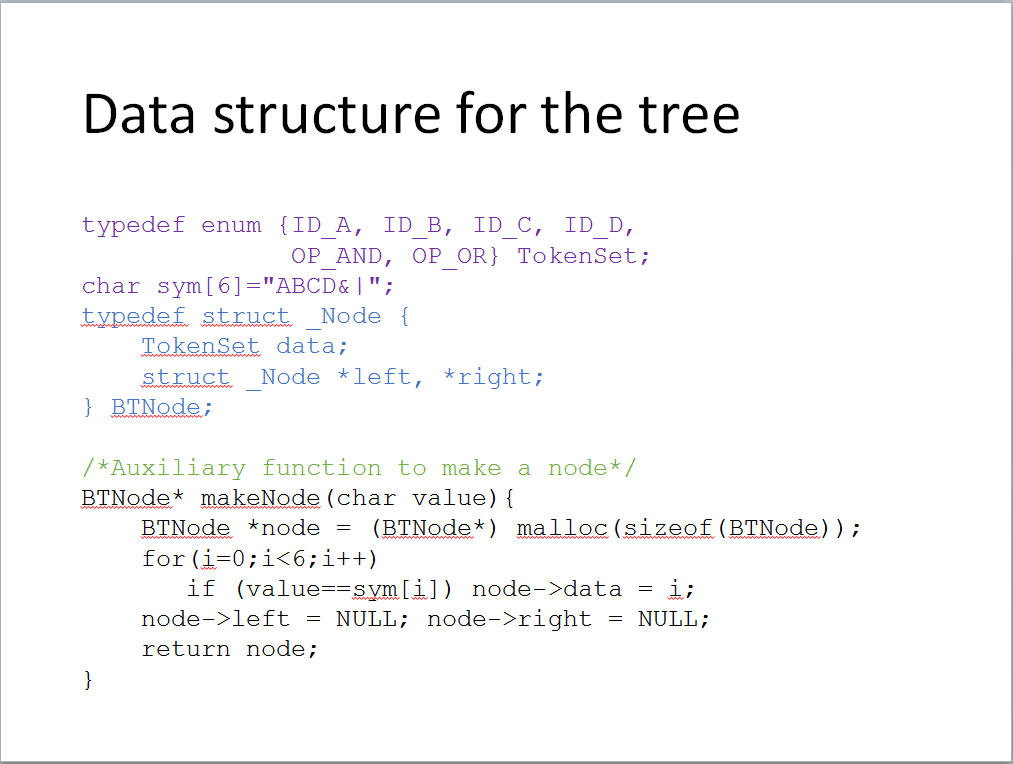
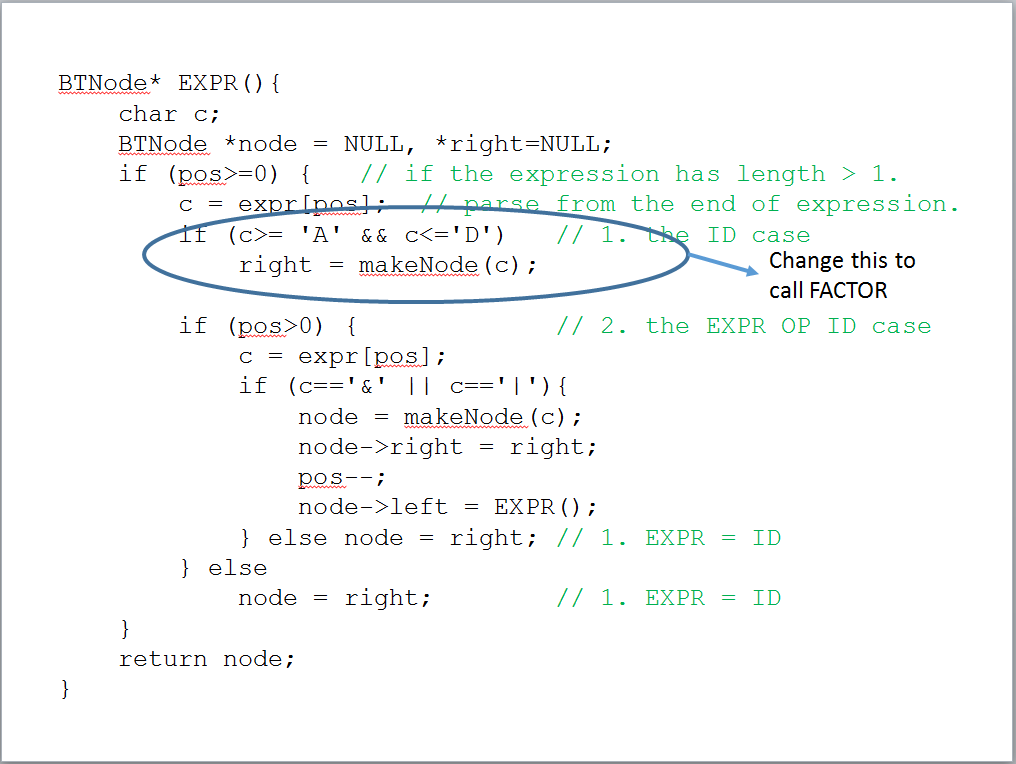
You will be provided with main.c and function.h. main.c contains the implementation of functions printPrefix and freeTree. function.h contains the definition of tree node and variables. You only need to implement the following three functions in function.c.
BTNode* makeNode(char c) // create a node without any child
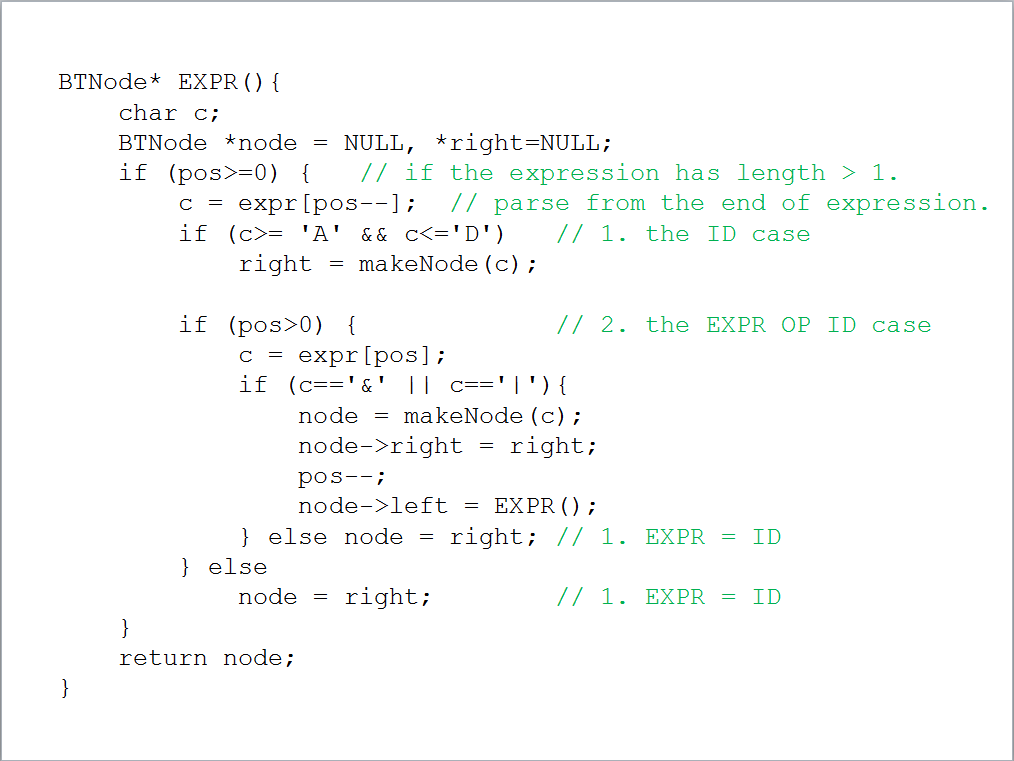
BTNode* EXPR() // parse an infix expression and generate a syntax tree
BTNode* FACTOR() // use the parse grammar FACTOR = ID | (EXPR) to deal with parentheses
For OJ submission:
Step 1. Submit only your function.c into the submission block.(Please choose C compiler)
Step 2. Check the results and debug your program if necessary.
Input
The input contains N infix expressions, which has at most 4 variables ‘A’, ’B’, ‘C’, and ‘D’, two operators ‘&’ and ‘|’, and parentheses. All parentheses are matched.
Output
The output contains N prefix expressions without parentheses, which are preorders of syntax trees.
Sample Input Download
Sample Output Download
Partial Judge Code
10966.cPartial Judge Header
10966.hTags
Discuss
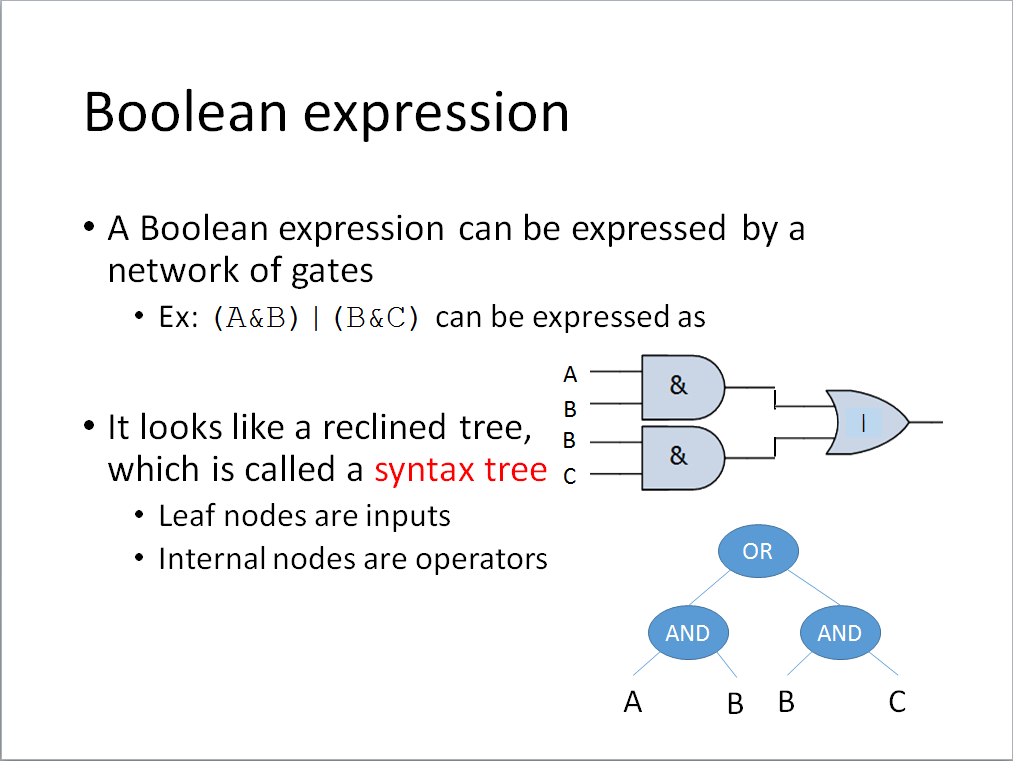
Description
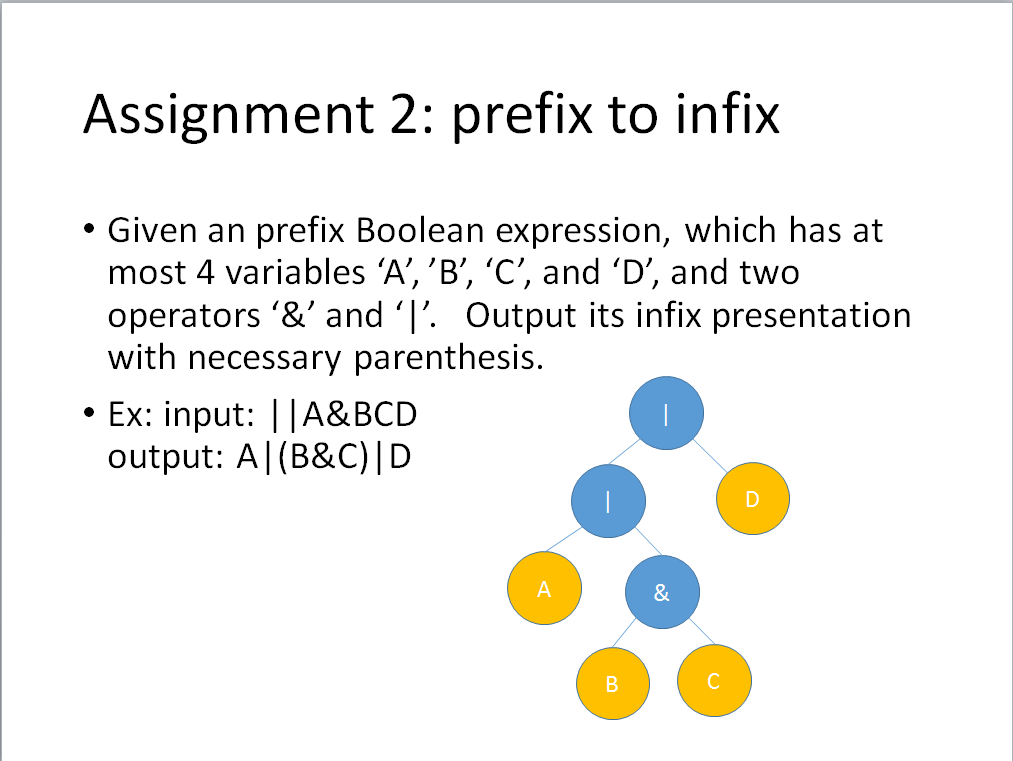
Given an infix Boolean expression with parentheses, which has at most 4 variables ‘A’, ’B’, ‘C’, and ‘D’, and two operators ‘&’ and ‘|’. Please remove unnecessary parentheses and print the infix expression. Existence of unnecessary parentheses doesn’t affect the result of expression. For example,
(A&B)|(C&D) → A&B|(C&D)
(((A|B))) → A|B
Hint: You can combine two homework. Build a syntax tree and print the infix expression with necessary parentheses.
For OJ submission:
Step 1. Submit your main.c into the submission block.(Please choose C compiler)
Step 2. Check the results and debug your program if necessary.
Input
The input is an infix expression, which has at most 4 variables ‘A’, ’B’, ‘C’, and ‘D’, two operators ‘&’ and ‘|’, and parentheses. The length of the infix expression is less than 256.
Output
The output is an infix expression without unnecessary parentheses.
Sample Input Download
Sample Output Download
Tags
Discuss
Description
The Josephus problem is notoriously known. For those who are not familiar with the problem, among n people numbered 1, 2, . . . , n, standing in circle every mth is going to be executed and only the life of the last remaining person will be saved. Joseph was smart enough to choose the position of the last remaining person, thus saving his life to give the message about the incident.
Given a group of n men arranged in a circle under the edict that every m man will be executed going around the circle until only one remains. Find the position in which you should stand in order to be the last survivor.
Input
Each line with 2 integers, n, m. n is the number of people. m is the number that every m person is executed. Input terminated by EOF.
Output
The output will consist in separate lines containing the position of the person which life will be saved. Each line should be ended with a newline character '\n'.