| # | Problem | Pass Rate (passed user / total user) |
|---|---|---|
| 11021 | Encoding and decoding |
|
| 11022 | Linked-list-based binary search trees |
|
| 11023 | Matrix |
|
Description
The task is to define the class ‘RleCodec’ for run-length encoding.
About implementing the virtual function:
We have the base class ‘Codec’ as an interface. The member functions in ‘Codec’ are pure virtual functions. Therefore we need to implement those virtual functions in the derived class ‘RleCodec’. The functions ‘decode’, ‘show’, ‘is_encoded’ are already done. The only function you need to complete is ‘RleCodec::encode’ in ‘function.cpp’.
In ‘main.cpp’, we see two functions having an argument of type ‘Codec&’:
std::ostream& operator<<(std::ostream& os, Codec& data);
void encode_decode(Codec& data);
Since ‘RleCodec’ is a derived class of ‘Codec’, we may pass an object of
‘RleCodec’ to the above two functions by reference as if it is an object of ‘Codec’. Calling ‘data.show(os);’ will invoke the virtual function of the corresponding derived class.
About run-length encoding:
The rule of run-length encoding is simple: Count the number of consecutive repeated characters in a string, and replace the repeated characters by the count and a single instance of the character. For example, if the input string is ‘AAADDDDDDDBBGGGGGCEEEE’, its run-length encoding will be ‘QCAQGDQBBQEGQACQDE’, where QCA means that there are 3 A’s and 3 can be encoded as C (the third character in alphabet), QGD means that there are 7 D’s and 7 can be encoded as G (the 7 th character in alphabet), and QBB means we have 2 B’s and 2 can be encoded as B (the second character in alphabet) … etc. Note that every encoding segment starts with a Q.
If there are 27 A’s in a string, it is separated into two segments ‘QZAQAA’, which means the first segment ‘QZA’ represents 26 A’s, and the second segment ‘QAA’ represents 1 A.
In ‘function.h’, we add the class ‘DummyCodec’ as a sample of implementing a derived class of the base class ‘Codec’. You do not need to change anything in ‘function.h’. The only function you need to write for this problem is the function ‘RleCodec::encode’ in ‘function.cpp’.
Hint: std::stringstream could be useful in solving this problem. Please refer to ‘RleCodec::decode’ for how to use std::stringstream.
You only need to submit ‘function.cpp’. OJ will compile it with ‘main.cpp’ and ‘function.h’.
We have already provided partial function.cpp belowed.
Note that if you can't use "auto".
For codeblock, go to the codeblock menu Settings --> Compiler ... --> Compiler flags and check Have g++ follow the C++11 ISO C++ language standard [-std=c++11]
For command line compiler, use g++ myprog.cpp -std=c++11 -o myprog
main.cpp
function.h
function.cpp
Input
A line contains of several characters .(n <= 100)
Output
There are four lines.
The first and second lines are dummy encoding and decoding. You don't need to implement it.
The third and forth lines are RLE encoding and decoding.
Each line is followed by a new line character.
Sample Input Download
Sample Output Download
Partial Judge Code
11021.cppPartial Judge Header
11021.hTags
Discuss
Description
A binary search tree (BST) is a binary tree, whose internal nodes each store a key and each have two sub-trees, commonly denoted left and right. The tree additionally satisfies the property: the key in each node must be greater than all keys stored in the left sub-tree, and smaller than all keys in the right sub-tree.
Let’s see how the BST data structure can be realized in C++ using a linked structure. We define three classes and use polymorphism as follows:
function.h
main.cpp
where
- Class BST serves as the abstract base class for realizing polymorphism
- List_ BST provide an approach to implementing the BST data structure
REQUIREMENTS:
- Implement the insert and createLeaf member functions of the List_ BST class.
Note:
1. This problem involves three files.
- function.h: Class definitions.
- function.cpp: Member-function definitions.
- main.cpp: A driver program to test your class implementation.
You will be provided with main.cpp and function.h, and asked to implement function.cpp.
2. For OJ submission:
Step 1. Submit only your function.cpp into the submission block.
Step 2. Check the results and debug your program if necessary.
Input
There are three kinds of commands:
- “I A”: insert a node with int value A(A>0) into the BST. If the key already exists, you simply do nothing.
- “P”: show the current content of the BST.
- “H”: print the BST’s height. Remember if the BST is empty, the height is 0 and you should print “0”.
Each command is followed by a new line character.
Input terminated by EOF.
Output
The output shows the result of each command.
Sample Input Download
Sample Output Download
Partial Judge Code
11022.cppPartial Judge Header
11022.hTags
Discuss
Description
Create a class Matrix to represent an N * N matrix.
Provide public member functions that perform or derive:
1) Matrix &clockwise90();
Rotate a Matrix by 90° clockwise.
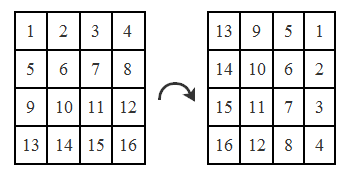
NOTE:
If a is a Matrix, the result of a.clockwise90() should be stored back into a. Remember to return the object itself for the use of operation concatenation, such as a.clockwise90().clockwise90(). (You can refer to member function “Matrix &operator=” in function.h.)
2) Overload the stream extraction operator (>>) to read in the matrix elements.
3) Overload the stream insertion operator (<<) to print the content of the matrix row by row. Note that
all of the integers in the same line are separated by a space, and there is a new line character at the
end of each line.
Note:
1. This problem involves three files.
- function.h: Class definition of Matrix.
- function.cpp: Member-function definitions of Matrix.
- main.cpp: A driver program to test your class implementation.
You will be provided with function.h and main.cpp, and asked to implement
function.h
main.cpp
2. For OJ submission:
Step 1. Include function.h into function.cpp and then implement your function.cpp. (You don’t need to modify function.h and main.cpp)
Step 2. Submit the code of function.cpp into submission block.
Step 3. Check the results and debug your program if necessary.
Input
The first line has an integer N (1<=N<=50), which means the size of the matrix. The total number of elements in the matrix is thus N * N.
For the next N lines specify the elements of the matrix a. All of the integers in the same line are separated by a space.
Output
Your program should print the corresponding results followed by a new line character.