Description
Morse code is a way to represent English letters (here we only consider capital letters). The code is composed of some long signals and some short signals. For convenience, we represent a long signal as '-' and represent a short signal as '*'. Then ‘/’ is used to serve as a blank that distinguishes each word that consists of several letters.
For example, ''NPSC GG'' is ''-* *--* *** -*-* / --* --*", where “-*” = N and “*--*” = P, and the code for other letters is shown below.
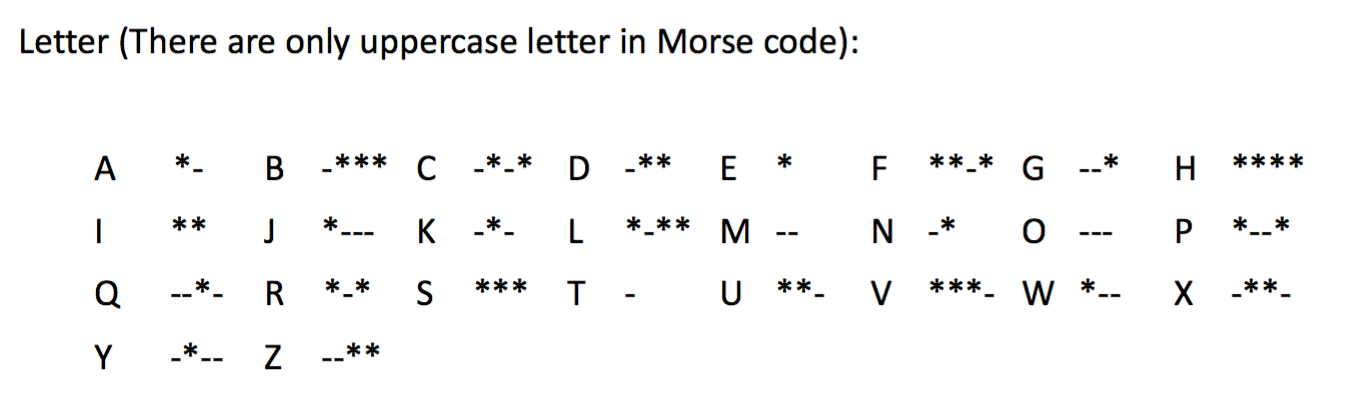
However, these long and short signals in the Morse code cannot be represented using gesture. A way to simulate the long and short signals is as follows:
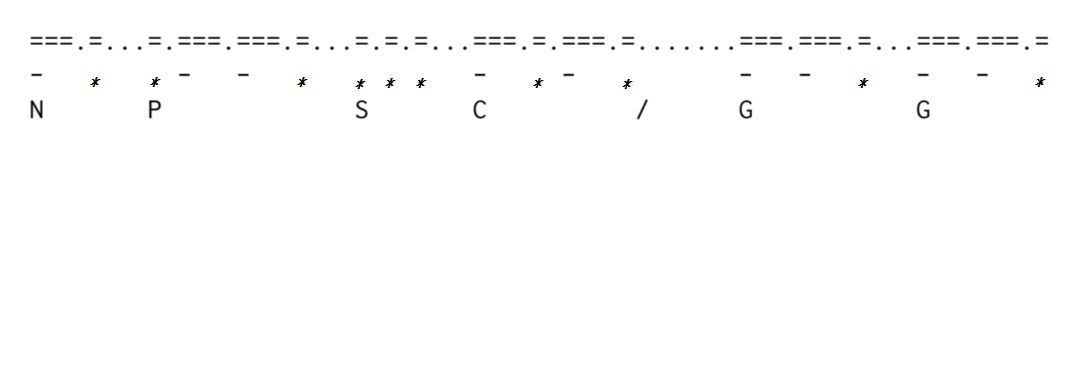
- “===” represents a long signal. (hitting table for 3 times)
- “=” represents a short signal. (hitting table for 1 time)
- For a letter, “.” is used as a pause to separate signals.
- In a word, “…” is used as a pause to separate letters.
- “…….” is used to separate words (that is, to represent ‘/’ as mentioned above).
For example, “NPSC GG" can be encoded as follows:
P.S the problem is from 2015 網際網路程式設計全國大賽
Input
There are two lines. The first line is an integer N, meaning the second line will give a string with length N, and this string is only composed of '=' and '.'.
.N <= 999.
.The output string begins and ends with a non-blank letter.
Output
Print the result after decoding
Following is a sample test case:
Input:
57
=.===...===.=.=.=...===.=.===.=...===.=.=...=...=.=.===.=
Output:
ABCDEF