Description
Define a subclass of tuple such that it supports the __contains__ special method
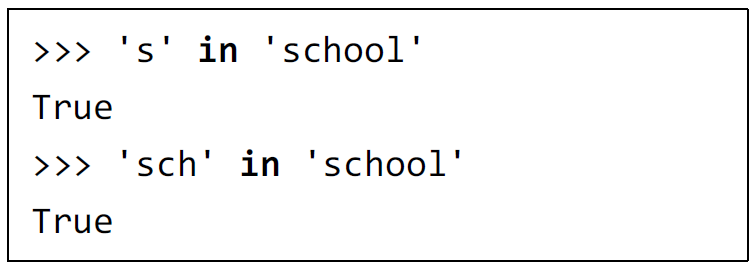
(corresponding to the in operator in reverse) that works similar to the str version.
For your information,
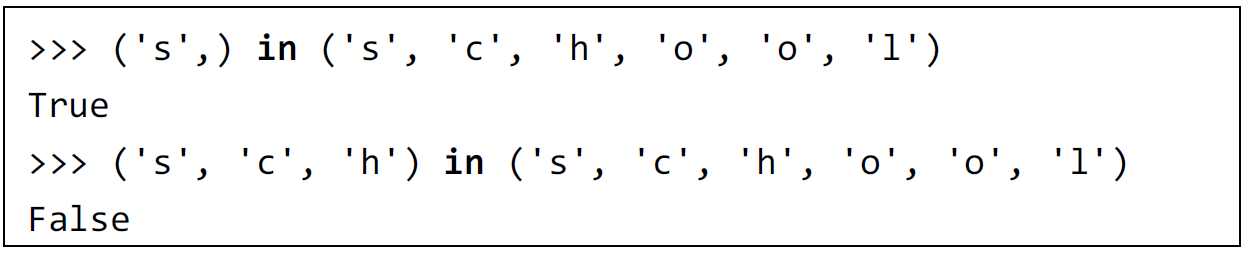
But tuple does not support slice containment:
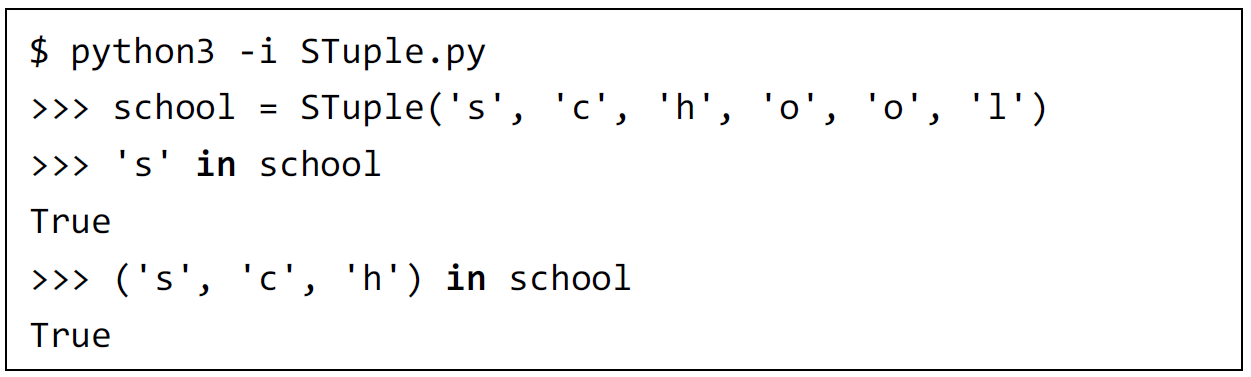
Define a subclass of tuple named STuple such that containment works for both
elements and slices:
''' you should use the template of following.'''
import ast
class STuple(tuple):
'''inherit constructor'''
def __contains__(self, item):
#coding on here
#coding on here
#coding on here
if __name__ == '__main__':
pat = ast.literal_eval(input()) # pattern input
testSeq = ast.literal_eval(input()) # test case input
for p in pat:
for t in testSeq:
print(f'{p} in STuple{t} =', p in STuple(t))
Input
['o', 's', ('s', 'c', 'h'), (), ('o', 'o')]
[(), ('s', 'c', 'h', 'o', 'o', 'l'), ('s', 'c', 'h'), ('k', 'o' 'o', 'l'), ('o', 'o', 'l')]
Output
o in STuple() = False
o in STuple('s', 'c', 'h', 'o', 'o', 'l') = True
o in STuple('s', 'c', 'h') = False
o in STuple('k', 'oo', 'l') = False
o in STuple('o', 'o', 'l') = True
s in STuple() = False
s in STuple('s', 'c', 'h', 'o', 'o', 'l') = True
s in STuple('s', 'c', 'h') = True
s in STuple('k', 'oo', 'l') = False
s in STuple('o', 'o', 'l') = False
('s', 'c', 'h') in STuple() = False
('s', 'c', 'h') in STuple('s', 'c', 'h', 'o', 'o', 'l') = True
('s', 'c', 'h') in STuple('s', 'c', 'h') = True
('s', 'c', 'h') in STuple('k', 'oo', 'l') = False
('s', 'c', 'h') in STuple('o', 'o', 'l') = False
() in STuple() = True
() in STuple('s', 'c', 'h', 'o', 'o', 'l') = True
() in STuple('s', 'c', 'h') = True
() in STuple('k', 'oo', 'l') = True
() in STuple('o', 'o', 'l') = True
('o', 'o') in STuple() = False
('o', 'o') in STuple('s', 'c', 'h', 'o', 'o', 'l') = True
('o', 'o') in STuple('s', 'c', 'h') = False
('o', 'o') in STuple('k', 'oo', 'l') = False
('o', 'o') in STuple('o', 'o', 'l') = True