Description
There is a grid with H horizontal rows and W vertical columns, and there are obstacles on some of the squares.
Snuke is going to choose one of the squares not occupied by an obstacle and place a lamp on it. The lamp placed on the square will emit straight beams of light in four cardinal directions: up, down, left, and right. In each direction, the beam will continue traveling until it hits a square occupied by an obstacle or it hits the border of the grid. It will light all the squares on the way, including the square on which the lamp is placed, but not the square occupied by an obstacle.
Snuke wants to maximize the number of squares lighted by the lamp.
You are given H strings Si (1 <= i <= H), each of length W. If the j-th character (1 <= j <= W) of Si is '#', there is an obstacle on the square at the i-th row from the top and the j-th column from the left; if that character is ., there is no obstacle on that square.
Find the maximum possible number of squares lighted by the lamp.
Take below map for example:
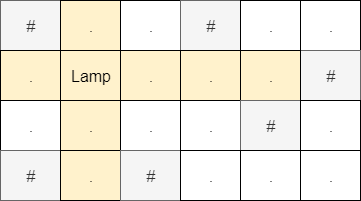
8 is maximum possible number of squares lighted by the lamp. (lamp placed on second row and second column)
Input
H W
S1
...
SH
H: the lenght of the row (1 <= H <= 2500)
W: the lenght of the column (1 <= W <= 2500)
Si : the row information (contain '.' or '#')
Output
Output The maximum number of squares lighted by the lamp. (the output string followed by a newline character.)