Description
There’re N banks around the world.
Transactions happen many times every day.
In order to maintain the financial balance, the bank i transfers some money to the bank j once per day.
The amount of transferred money is [ the money of the bank i ] × [ the transfor rate from bank i to bank j ]
Some banks may declare bankrupts because of economic recession.
Let’s say a bank go bankrupt if and only if the money of this bank is less than 10$.
If such situation happens, the bankrupted bank will stop transforing or receiving moneys from any other bank.
Furthermore, the other banks will save the money which should transfor to the bankrupted bank as their own property.
Your task is to compute the amount of money in each bank after T days.
For example:
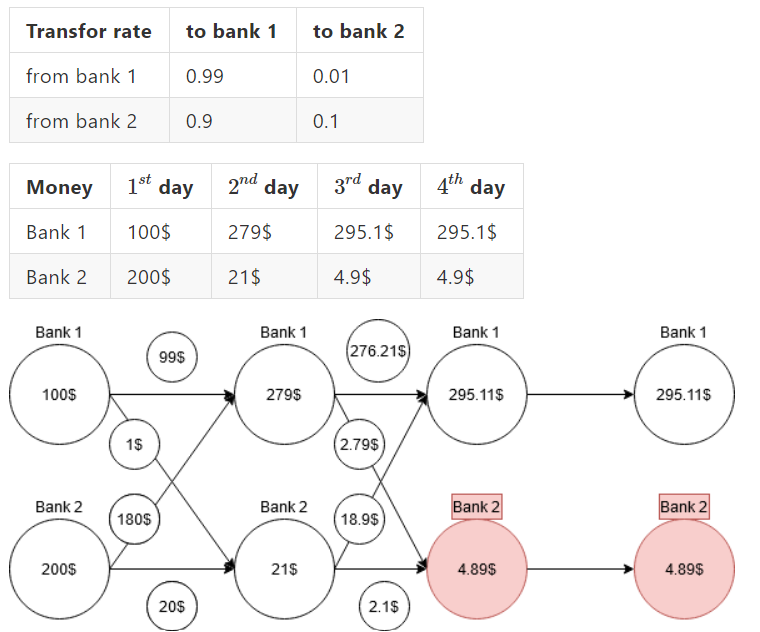
The transfor rate and the money of each bank are shown in the following tables.
The bank 2 declared a bankrupt on the 3rd day.
Therefore, the bank 1 stop transforing money to bank 2 after the declaration.
Input
Two numbers N, T on the first line.
The following N lines contains xi per line, denoting the money which bank i has in the begining.
The next N lines consist N numbers for each lines.
There’re ri1, ri2, ... , riN in the ith line, representing the transfor rate from bank i to bank j.
It is guaranteed that:
- 1 ≤ N ≤ 500
- 1 ≤ T ≤ 1000
- 10 ≤ xi ≤ 106
- 0.0 ≤ rij ≤ 1.0
Output
There’re N lines in output.
The ith line contains the amount of money of bank i after T days.
Notice that the amount of money is rounded to 1 decimal places. ( 四捨五入至小數點第1位 )
Remember to print “\n” at the end of each line.