Description
Design a class named Pyramid which is derived from an existed class named Rectangle.
Rectangle:
Protected Variables:
- l(int) as rectangle’s length.
- w(int) as rectangle’s width.
note that 0 <= l, w <= 100.
Constructors:
- The default constructor of the class should initialize l, and w to 0.
- The parameterized constructor Rectangle(int _l, int _w) should initialize rectangle's l, and w to _l, and _w.
Methods:
- int getLength() - Return rectangle's l.
- int getWidth() - Return rectangle's w.
- int calculateArea() - Return rectangle's area(l * w).
Pyramid:
Protected Variables:
- l(int) as pyramid’s length.
- w(int) as pyramid’s width.
- h(int) as pyramid’s height.
note that l, w is derived from Rectangle.
Constructors:
- The default constructor of the class should initialize pyramid’s l, w, h to 0.
- The parameterized constructor Pyramid(int _l, int _w, int _h) should initialize pyramid’s l, w, h to _l, _w, _h.
- The parameterized constructor Pyramid(Rectangle& rect, int _h) should initialize pyramid’s l, w, h to rect’s l, rect’s w, _h.
Methods:
- int getLength() - Return pyramid’s l.
- int getWidth() - Return pyramid’s w.
- int getHeight() - Return pyramid’s h.
- int calculateArea() - Return pyramid’s base area(l * w).
- double calculateVolume() - Return pyramid’s volume(1/3 * base area * h).
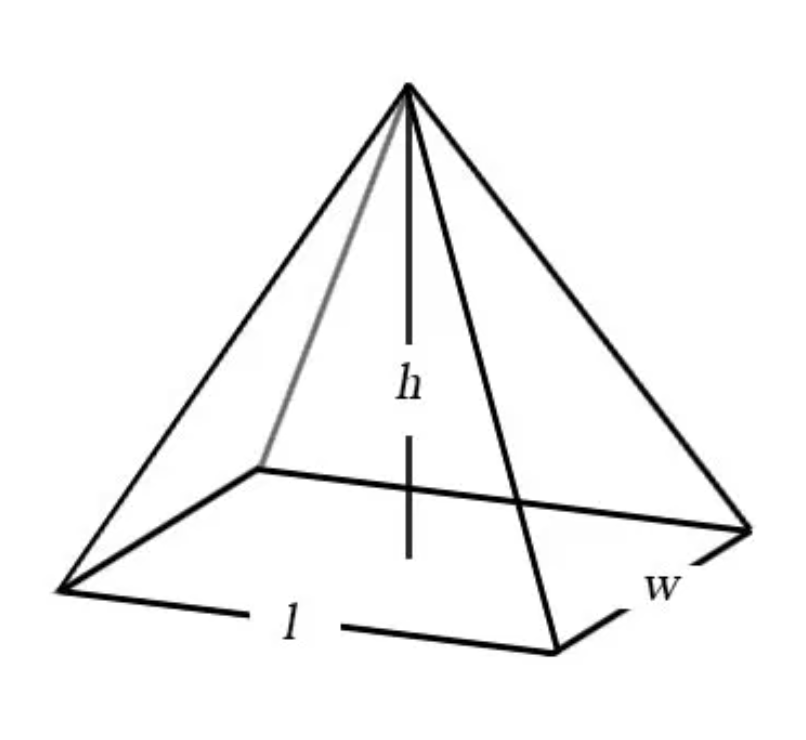
// YOU DON’T NEED TO IMPLEMENT BELOW TWO METHODS
- void printBasicInfo() – print Length: l, Width: w, Height: h. For example: “Length: 20, Width: 30, Height: 40”.
- void printFullInfo() – print Length: l, Width: w, Height: h, Area: base area, Volume: volume. For example: “Length: 20, Width: 30, Height: 40, Area: 600, Volume: 8000.00”. Note that, std::fixed() and std::setpercision(int) is help to print a floating variable to 2nd decimal place.
Example:
#include <iostream> // std::cout, std::fixed
#include <iomanip> // std::setprecision
std::cout << std::fixed << std::setprecision(2) << some_double_variable;
main.cpp
#include <iostream>
#include <iomanip>
using namespace std;
void check();
class Rectangle
{
public:
Rectangle() : l(0), w(0) {}
Rectangle(int _l, int _w) : l(_l), w(_w) {}
int getLength() { return l; }
int getWidth() { return w; }
protected:
int l, w;
int calculateArea() { return l * w; }
};
/* Todo */
// Create a class named Pyramid, derived from class Rectangle
// 1. Three constructors: Pyramid(), Pyramid(int _l, int _w, int _h), Pyramid(Rectangle& rect, int _h)
// 2. Four public methods: getHeight(), calculateVolume(), printBasicInfo(), printFullInfo()
/* You may use the below functions directly */
// void printBasicInfo() { cout << "Length: " << getLength() << ", Width: " << getWidth() << ", Height: " << getHeight() << endl; }
// void printFullInfo() { cout << "Length: " << getLength() << ", Width: " << getWidth() << ", Height: " << getHeight() << ", Area: " << calculateArea() << ", Volume: " << fixed << setprecision(2) << calculateVolume() << endl; }
// 3. One protected variable: h
// Don't touch below functions when submitting the code
void check()
{
int testcase;
cin >> testcase;
if (testcase == 1)
{
Pyramid pyrm1 = Pyramid();
pyrm1.printBasicInfo();
Pyramid pyrm2 = Pyramid(3, 4, 5);
pyrm2.printBasicInfo();
}
if (testcase == 2)
{
Pyramid pyrm1 = Pyramid();
pyrm1.printFullInfo();
Pyramid pyrm2 = Pyramid(13, 14, 15);
pyrm2.printFullInfo();
}
if (testcase == 3)
{
Rectangle rect = Rectangle(10, 10);
Pyramid pyrm = Pyramid(rect, 30);
pyrm.printFullInfo();
}
if (testcase == 4)
{
Pyramid pyrm1 = Pyramid(23, 34, 55);
pyrm1.printFullInfo();
Rectangle rect = Rectangle(11, 11);
Pyramid pyrm2 = Pyramid(rect, 17);
pyrm2.printFullInfo();
}
if (testcase == 5)
{
Pyramid pyrm = Pyramid(100, 100, 100);
pyrm.printFullInfo();
}
}
int main()
{
check();
return 0;
}
Input
No need to handle input. (Input would be number 1~5 to represent the index of test-case)
Output
No need to handle output.